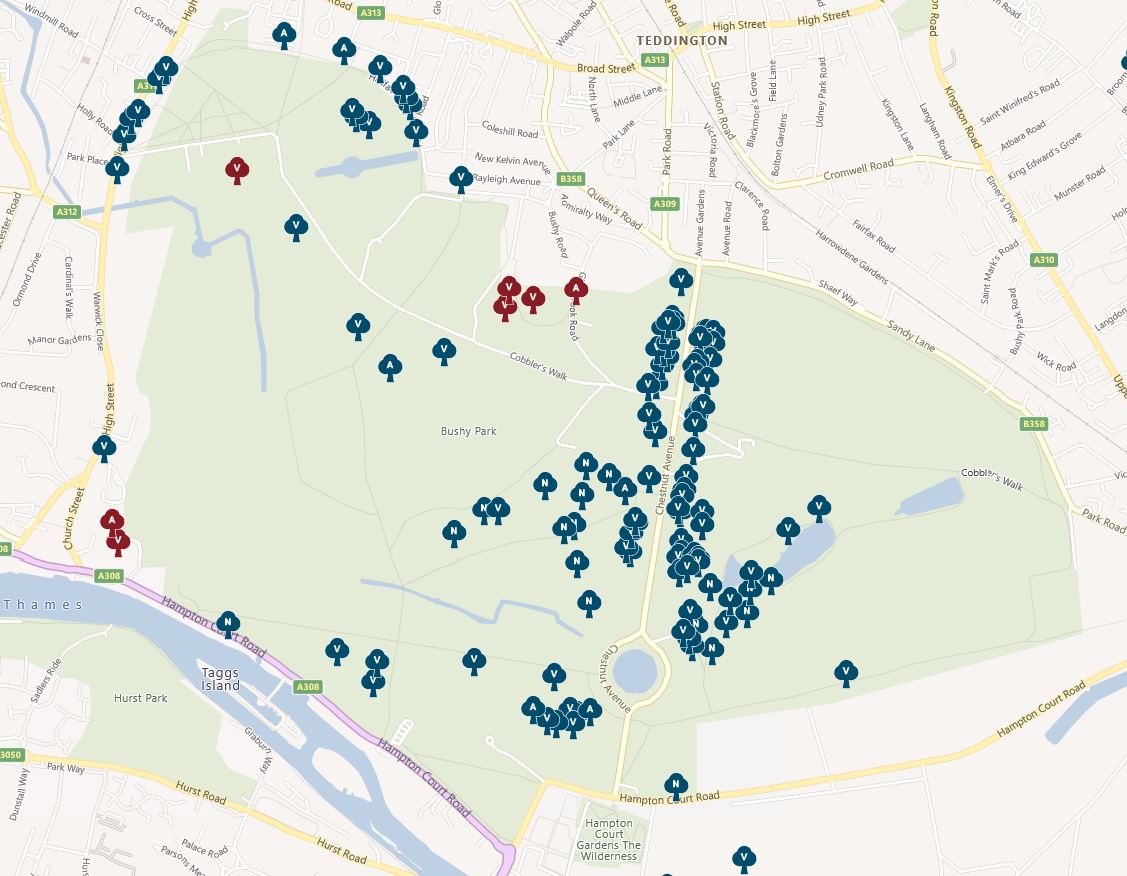
Set up by the Ancient Tree Forum, the Woodland Trust and the Tree Register, the Ancient Tree Inventory is a mapped record of more than 160,000 ancient or old trees within the UK.
The aim of this inventory is to help protect and care for these extraordinary beings that link us mere mortals with our history, culture and ecology.
According to Woodland Trust’s website, the inventory has three categories of trees:
- Ancient
- Veteran
- Notable
I have copied the following information from Woodland Trust’s website as my guide for reference.
Ancient trees
An ancient tree is in the third and final stage of its life. How old an ancient tree is depends on the species. Some species can live longer than others with yews, oaks and sweet chestnuts topping the age charts at over 1000 years.
What is an ancient tree?
How old an ancient tree is depends on the species. Some species can live longer than others with yews, oaks and sweet chestnuts topping the age charts at over 1000 years. Other species, including birch and willow, live shorter lives.
A tree is defined as ancient if it is
- In the third or final stage of its life (this stage can go on for decades or centuries)
- Old relative to others of the same species
- Interesting biologically, aesthetically or culturally because of its great age
What do ancient trees look like?
Ancient trees don’t always look the same, depending on the species and where it grows. But in general, there are several ancient characteristics and the more a tree has the older it’s likely to be.
Key Features:
- Crown that is reduced in size and height
- Large girth in comparison to other trees of the same species
- Hollow trunk which may have one or more openings to the outside
- Stag-headed appearance (look for dead, bare, antler-like branches in the crown)
- Fruit bodies of heart-rot fungi growing on the trunk
- Cavities on trunk and branches, running sap or pools of water forming in hollows
- Rougher or more creviced bark
- An ‘old’ look with lots of character
- Aerial roots growing down into the decaying trunk
Veteran trees
A veteran tree will have some of the features found on an ancient tree, but won’t have the great age. Although they’re not as old as ancient trees, they’re still incredibly important.
What is a veteran tree?
Ancient trees are veteran trees, but not all veteran trees are old enough to be ancient.
Veteran trees are survivors that have developed some of the features found on ancient trees. However, veteran trees are usually only in their second or mature stage of life.
There may be signs of decay, fungal fruiting bodies or dead wood, these features may start to appear in the mature stage and also in traditional pollards.
Although veteran trees aren’t as old or complex as ancient trees, they still provide holes, cavities and crevices which are especially important for wildlife.
Notable trees
Notable trees are usually mature trees which may stand out in the local environment because they are large in comparison with other trees around them.
They don’t have any obvious veteran characteristics, but may be taller than ancients and fatter than some veterans.
In parts of the UK, where trees are less common, a tree may be relatively small and young but notable because it is significant in its local environment.
Notable trees are usually worthy of recognition and can be potential, next generation veteran trees.
Lost trees
These are trees which have already been recorded, but are later discovered to have been cut down, blown over, collapsed, or otherwise removed, leaving no more than a low stump.
A new tree record can’t be added as a lost tree, although it can be recorded as a remnant e.g. stump. The Ancient Tree Inventory will use this information to assess the rate of recent loss of our ancient trees.
A tree originally recorded as a standing dead ancient tree remains this until it’s cut down or is removed; it can then be updated to a lost tree.
If known, the loss will need to be reported then included with the entry.
Also on this website is a very useful guide to the characteristics of each main species of tree: https://ati.woodlandtrust.org.uk/how-to-record/species-guides/.
These set of guides includes the hawthorn: https://ati.woodlandtrust.org.uk/how-to-record/species-guides/hawthorn/. I will be looking at that in more detail in a following post.
Out of curiosity, I looked at the current inventory of trees in Bushy Park.
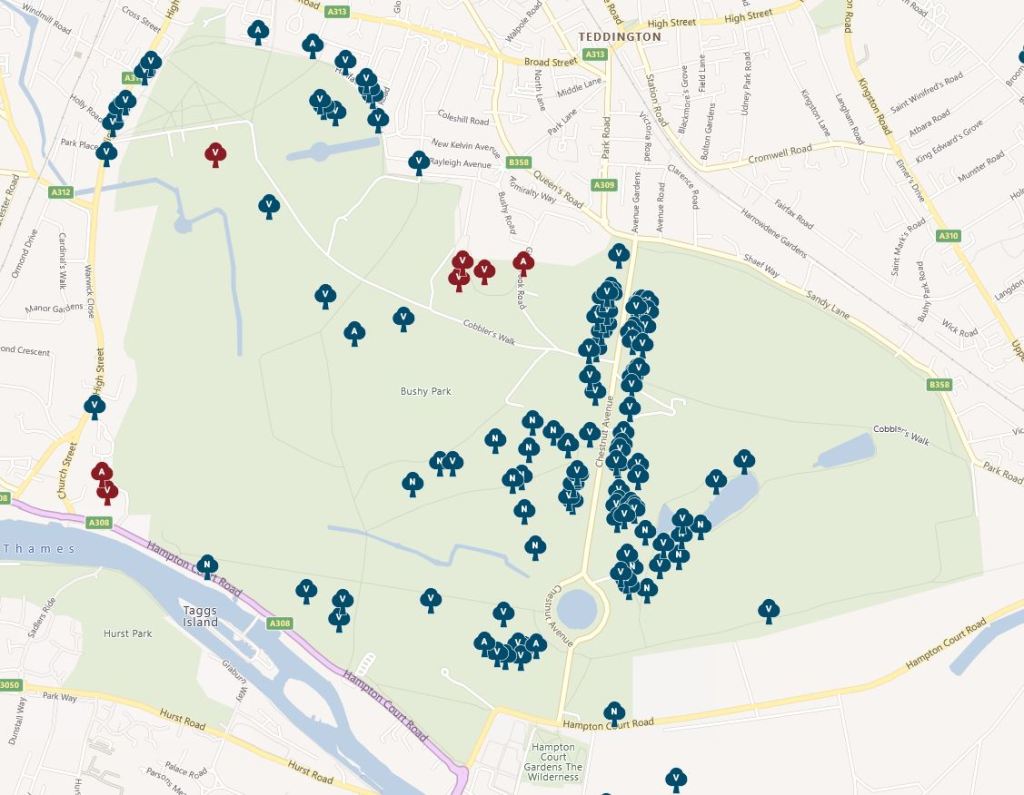
I can tell just by looking at this map there are several trees fulfilling the three categories that have not been registered. Very interesting.
References
Woodland Trust. 2020. [online] Available at: <https://ati.woodlandtrust.org.uk/; [Accessed 20 October 2020].
 Jennie Meadows MA Photography