Author: jenniemeadows


Further to the 14th July interim review the final weeks of the summer period are enable my production of final work for Assessment Task 1 to be resolved for exhibition display and assessment.
Unfortunately, due to personal circumstances I was unable to attend this essential session.
The following is an adapdation of the email received from the Module Leader, Fergus Heron, on 16th July 2021.
I will plan the forthcoming independent study period to carry out professional standard realisation and preparation of my final work accordingly.
The module supports acquisition of skills in the preparation of work for exhibition display as described in the module handbook and specification (LO4).
This Learning Outcome 4 for AGM64 is to:
I am, therefore, required to show an example of my work, fully realised with appropriate attention to details of framing and/or installation in exhibition display for Assessment Task 1: Submission of a body of photographic work.
AGM64 Assessment Task 1 is to:
Task 1 (70%): For me to submit a Body of Photographic Work in an appropriate form, e.g. portfolio of prints, gallery installation, projection.
The exhibition display of final work is curated by staff as described in the module specification. This is to ensure thematic coherence and to enable as effective preparation as possible for future professional exhibiting practice.
Preparing my work is most usefully understood as part of the process of participating in an independently curated group show and not as a solo show.
Completion and Submission of Exhibition Display Proposal Forms
A proposal form for final exhibition display accompanying this guidance was available for download and completion from the Module Information folder. I eventually found it and here is the blank version on which I will base my proposal.
I will read the notes in the form and complete with as much detail as possible.
- Once I have completed the exhibition proposal form, I will submit the form through Turnitin via the assessment area in the module folder on Student Central
- Deadline for me to submit my exhibition proposal form is Monday 2 August at 23:59
- Response to my proposal will be provided by staff on Friday 6 August by 12:00
Submitting Work
It is understood that it may not be possible to prepare all final work for exhibition display for a variety of reasons. Therefore, my options for submission of the final body of work include:
- Exhibition – all final work submitted for exhibition display
- Portfolio – final work mostly presented in a folio box with one to three example/s prepared for exhibition display
- Exhibition and Portfolio combination – a selection of work prepared for exhibition display with an additional volume presented in a folio box
Please note that my work will be marked according to how published learning outcomes are achieved regardless of which of the foregoing options are taken.
There is no need for me to duplicate work from exhibition in a portfolio – or vice versa.
With the option of assessment by exhibition display only – I must be aware of the integrity of my work in balance with a realistic use of space as part of a group show.
A useful guide for estimation of space would be around five meters for display of prints on the wall. I have to admit that I have no idea if that is 5 meters square or 5 metres across. I will have to clarify this with Fergus before going ahead with my proposal.
I will also take in consideration that works will be allocated more or less space as appropriate in the interests of the overall coherence and effectiveness of the display.
Invigilation
There is no requirement for myself or any of the student cohort to invigilate exhibition this year. Displays of work will occupy secure areas of university buildings monitored by CCTV.
Display Methods
Methods of display appropriate to my work was to have been discussed at interim review.
As I wasn’t able to attend, I will raise this with the Module Leader, Fergus Heron. At this stage, I have an idea as to what work will be displayed and how, but nothing concrete.
What is certain at this stage is that I have concerns and uncertainties due to the lack of communication and the missed key session of the final Mid-Review on 14th July.
The following was suggested by Fergus:
A common contemporary form of professional display for smaller works involves taping prints invisibly to the wall using a combination of masking tape and double-sided tape; masking tape applied to reverse edges of the print and correspondingly onto the wall is joined with double sided tape.
Alternative taping methods include attaching lengths of invisible tape to the reverse of the print with a half width of the adhesive side of the tape facing forwards that is subsequently taped to the wall. This method avoids contact with the print surface. Please consult staff for further detail.
Other fixing options include pins/nails applied to the corners of prints driven into the wall. Consider the appropriate type of pin/nail and print border if this is a preferred display option.
Print mounting is usually desirable and sometimes necessary for larger work.
If considering mounting and framing work for exhibition, ensure a professional print mounting service and/or framer with knowledge and experience of mounting/framing photographs as artworks for exhibition is consulted and commissioned.
Mounting options include Spectrum Photographic (Brighton) and Metro Imaging (London)Professional Photo Printing + Mounting – Spectrum PhotographicProfessional photo & giclée printing, exhibition quality master printing, and mounting, all to archival museum standards
Metro Imaging – Professional Photo Printing, Mounting and Framing
Recommended locally based framers (Brighton and Lewes):
https://www.rainsfordjames.com/
Professional standard frames can be ordered online:HALBE-Rahmen GmbHBuy Picture Frames & Accessories in our online shop ✓high quality frames made to measure ✓aluminium or solid wood ✓many colours & sizes. Order now!HALBE-Rahmen GmbH
Check shipping rates from EU*
London based art and conservation framers include:
https://lockanddavies.co.uk/about
https://www.pendragonframes.com/Pure & Applied | London Picture Framing in SE1Pure & Applied, Conservation Picture Framing in London, SE1. Over 35 years’ experience including traditional and contemporary picture frames, canvas stretching, painting restoration & more. Visit us today.Pure&Applied
Be aware conservation framing can be costly and should be considered if financial resources are available for single or limited numbered works.
It is not essential to frame or mount work. Fastening prints to walls with tape or pins can be as – or more – effective depending on the nature of the work. However, if you choose to mount and/or frame, the work must be carried out to an appropriate professional standard.
All mounted and framed work should be ready to install with appropriate fixings that can include strap hangers, split battens, Ryman hangers, reverse mounted slotted plates, etc. Discuss requirements with the mounter/framer accordingly.
Lightweight mounted works (e.g. PVC or kapa board) can be secured with adhesive fasteners such as 3M command strips that are widely available and should be supplied by you with the work upon submission.
Staff with exhibition curation responsibility reserve the right to exclude any ineffectively or inappropriately presented work from the exhibition display. If you are in any doubt about presentation of work for exhibition, or if you have any questions, contact the Module Leader.
Projection Installation and Screen-Based Work
I need to discuss equipment requirements and details of planning with staff as early as possible. It is essential that any projection installation or screen-based work is ready to install according to plan.
Considering my current circumstances, I know the best strategy is to keep things simple and focus on physical prints and a portfolio. I do either want or need further stress configuring further work for either projection or creating a screen-based piece. I am very disappointed that I feel unable to do so, but I have to pace myself and amount of work to enable me to complete my MA Photography successfully.
Risk Assessment
If my work is likely to involve any risk to myself, fellow students, staff or visitors, it is essential that a risk assessment is carried out and appropriate measures implemented. Please contact the Workshop Manager and Module Leader accordingly.
Exhibition Information Text and Contact Details
Displayed work may be seen by visitors. Information on displayed work will be situated in the building reception area as a written description with key to works on an A4 paper sheet. If I wish for your artist website and/or email address to be included please inform the Module Leader. Display area walls will feature works only.
Pricing and Selling Work
Any potential sales enquiries will be directed to individual students and should be independently negotiated following display take down.
Some useful advice on pricing and selling work is available on Artquest:ArtquestArtquest encourages critical engagement and provides practical support to visual artists throughout their careers.Artquest
Display Take Down and Collection of Work
Detailed arrangements about take down of displayed work will be notified through further Announcements in the My Studies module area.
I will ensure transport and storage arrangements are made for my work. Onward transportation and storage of work beyond the display cannot be arranged or provided by module staff. With thanks in advance for understanding.
I will be able to collect my portfolios submitted for assessment following marking and external moderation processes. Notification will be made through Announcements in My Studies.
Key Dates
Deadline for submission of completed exhibition proposal forms Monday 2 August
Deadline for submission of Task 1 coursework Tuesday 31 August by 13:00 to the office Edward Street 204 (submissions can be made from 13:00 on Tuesday 24 August by request to the Module Leader) Research Dossiers for Task 2 to be submitted through Turnitin by 23:59 on Tuesday 31 August.
Availability of work for collection Wednesday 8 September from 12 noon.
One part of Task 2 for AGM64 Photography Research Project Stage 2 is to give an Artist Talk of 20 minutes.
This is to fulfill the Learning Outcome 5, which is for me to demonstrate my ability to present my photographic practice in this particular form. The purpose of doing so will enable me to develop clear verbal articulation of photographic practice at a professional level.
The Artists Talks will be held on Wednesday 16 and Wednesday 23 June 2021. The following is notation of who will give their Artist Talk on which day and at what time.
Wednesday 16 June
10:00 – 10:30 Juliet Ballard
10:30 – 11:00 Huiyi Luo
11:00 – 11:30 Tony Da Vall
11:30 – 11:45 Break
11:45 – 12:15 Beth Nicholls
12:15 – 12:45 Elizabeth Doak
14:00 – 14:30 Abi Evans
14:30 – 15:00 Hanna Gabler
15:00 – 15:30 Miao Fu
Wednesday 23 June
10:00 – 10:30 Ola Teper
10:30 – 11:00 Bill Brooks
11:00 – 11:30 Lorraine Edridge
11:30 – 11:45 Break
11:45 – 12:15 Torz Dallison
12:15 – 12:45 Esme Follas-Shell
14:00 – 14:30 Mark Perkins
14:30 – 15:00 Jennie Male
15:00 – 15:30 Syl Ojalla
Talks will take place in MS Teams and I need to feature a slide show in assisting in my verbal presentation.
As such, I will ensure familiarity with MS Teams share screen and access to slide show file as required. If necessary, I will contact Technical Support via the University IT Service Desk as required.
Each talk will be of twenty minutes duration with a further ten minutes for questions, comments and discussion.
My talk should be evidenced appropriately in the required Research Dossier to be submitted for assessment as part of Task Two. An illustrated transcript or a link to MS Teams recording can be included as appropriate.
To support preparation, I will look at good online examples of recorded artist talks include Tate Shots, ICP Lecture Series, Arts Council etc.
I will also look at the Module’s Study Materials which feature a selection of examples of online recorded artist talks for reference.
I will, along with all Full-Time and Part-Time Year Two Students, attend both days of talks for the full duration and I should be prepared to offer and accept supportive feedback with my classmates.
Webs, blogs, e-books, audiovisuals, slide projections, and other image-text platforms.
Hybrid practices and narratives.
Moving image and sound in e-books.
Suggested Reading/eBooks/Websites
Project Websites/Books
Dana Lixenberg Imperial Courts Project (2015)
Homepage
Dana Lixenberg The Last Days of Shishmaref (2009)
http://www.paradox.nl/project/lastdaysofshishmaref
Susan Meiselas, Kurdistan. In the Shadow of History (1997)
Gert van Kesteren, Why Mister Why? (2004)
http://www.paradox.nl/project/why-mister-why/ – book&gid=2&pid=2
Ursula Biemann, Becoming Earth (2021)
https://becomingearth.net/home
https://www.geobodies.org/books-and-texts/becoming-earth
eBook publishers
issuu
Start today
Issuu Donwloader
For example, Oil in Paradise: https://issuu.com/xparadox/docs/14_06_02_app_singlepages_2
Viscosity – Mobilizing Materialities: https://issuu.com/umndesign/docs/viscosity–
mobilizing_materialities
Unprinted Books available only in PDF format
Carola Ureta Marín, La Ciudad como Texto / City as Text, 2020
eBook magazine
For example, this issue on trees: https://emergencemagazine.org/story/atomic-tree/
https://www.canopycanopycanopy.com
eBooks
Susan Meiselas, Chile from Within, Digital edition (buy eBook) Mack, 2013
Adam Broomberg and Oliver Chanarin, War Primer II. Digital edition (free download eBook) by
Mack 2012
Lewis Bush, War Primer 3, 2013-15 http://www.lewisbush.com/war-primer-3/eBook/Tablet
Antony Cairns, LDN EI (2015) see: https://vimeo.com/125473327
Augmented Reality (AR) book
Lucas Blalock, Making Memeries (2016):
http://shop.selfpublishbehappy.com/product/making-memeries-by-lucas-blalock
Visual Storytelling New York Times, The Telegraph, etc
Collectives Websites
World of Matter: http://www.worldofmatter.net
Forensic Architecture (Eyal Weizman) http://www.forensic-architecture.org
Migropolis (Wolfgang Scheppe) http://www.migropolis.com
The Arab Image Foundation (Akram Zaatari) http://www.fai.org.lb/home.aspx
Platforms
Ydoc – Open platform for documentary (Paradox) http://www.ydocfoundation.org
Oil and Paradise – iPad App https://itunes.apple.com/us/app/oil-paradise/id885792805?mt=8
Artist’s Websites
Ariela Azoulay http://cargocollective.com/AriellaAzoulay
Aleix Plademunt
Martin Seeds http://www.martinseeds.com
Project Websites
The Atlas Group (Walid Raad) http://www.theatlasgroup.org
Lisa Barnard’s The Canary & The Hammer: http://www.thegolddepository.com/home.html
Traces of Nitrate: http://www.tracesofnitrate.org
Research Sites
Centre for the Study of the Networked Image http://www.centreforthestudyof.net
The Photographer’s Gallery – Decision Space http://decision-space.com
The Photographer’s Gallery – Digital Programme
https://thephotographersgalleryblog.org.uk/category/digital-programme/
Slide Works / Books
Robert Smithson Hotel Palenque (1967-72) http://www.teachertube.com/video/hotel-palenque-117741
Robert Smithson, Itaca Mirror Trail (1969)
http://www.tate.org.uk/art/artworks/smithson-ithaca-mirror-trail-ithaca-new-york-t07868
Robert Smithson, Hotel Palenque (1969-72), Alias (2011)
Nan Goldin The Ballad of Sexual Dependency (1985)
Matthew Buckingham One Side of Broadway (2005)
Photography books as Workshops
http://www.veteransbookproject.com/the-books/
Web Building
WordPress: https://wordpress.com
Cargo: http://cargocollective.com
Adobe Portfolio: https://www.myportfolio.com



Small group tutorials will take place on Wedneday 2 June. The following will be updated once these have taken place.
The purpose of these tutorials is to discuss project development in detail with reflection on feeback offered in intermin review. Advice in support of ongoing research and preparation for artist talks can also be offered in these sessions.
I will need to bring project work in progress for discussion.
The sessions will run for the morning only (10:00 – 13:00) in two parallel groups.
Room: ES305 with Fergus Heron
- Abi Evans
- Bill Brooks
- Esme Follas-Shell
- Huiyi Luo
- Juliet Ballard
- Mark Perkins
- Ola Teper
- Tony Da Vall
Room: ES304 with Xavier Ribas
- Beth Nicholls
- Elizabeth Doak
- Hanna Gabler
- Jennie Male
- Lorraine Edridge
- Miao Fu
- Syl Ojalla
- Torz Dallison
To be completed after the seminar.
Zines, visual essays, booklets, pamphlets, posters, postcards, scrapbooks.
High art and vernacular forms of the printed image.
The photographic book in the exhibition space and the museum gallery.
The photographic exhibition catalogue.
Suggested Reading
Bjarne Rogan, ‘An Entangled Object: The Picture Postcard as Souvenir and Collectible, Exchange and Ritual Communication’. Cultural Analysis, Volume 4, 2005.
David Campany, ‘Recalcitrant Intervention: Walker Evans’s Pages’. In Patrizia di Bello, Colette Wilson and Shamoon Nazir, The Photobook: From Tablot to Ruscha and Beyond. London, I.B.Tauris, 2012 (p.71-90).
Walter Benjamin, ‘Unpacking my Library. A Talk About Book Collecting’. In Illuminations, Schocken Books, 1969 (p. 59-67) http://art.yale.edu/file_columns/0000/2138/benjamin.pdf
Photography Books & Publications
Alberto Pérez-Gómez Polyphilo Or the Dark Forest Revisited: An Erotic Epiphani of Architecture (1992)
Aleix Plademunt, Ca l’Isidret newspaper publication (2012)
Andrés Durand, Monumento Editado (2017)
Ariane Pauls, The Fabric of Matter, The Matter of Fabric (2014)
Ariella Azoulay, Potential History: Photographic Documents from Mandatory Palestine. ‘folded
Carlos Spottorno The PIGS (2013)
David Campany A Handful of Dust (2015)
Delphine Bedel All That Is Solid Melts Into Air: Notes on Tourism (2008)
Edward Newton Others (2017)
Ernest Matthew Mickler, White Trash Cooking (1986)
exhibition’. Stuk, Louven and the Center for Digital Art, Holon (2012). Ariella Azoulay, Potential History:
Feng Li, White Night In Paris (2018)
Gregory Crewdson (et.al), Hover (1998)
Hans Waanders, different artist’s books
Jochen Lempert Studio 8 (2010); Four Frogs (2010)
John Gossage Hey Fuckface (2000) (Bootleg facsimile edition, 2015)
John Stathatos, Three Heraclitean Elements (1991)
Lewis Baltz Common Objects (2014)
Lewis Baltz Nevada (1978)
Lewis Baltz Rule Without Exception (1991)
Lothar Baumgarten Tierra de los Perros Mudos (1985); Amerika (1993); Amazonas Tapajos Xingu Purus
Lothar Baumgarten, Acces au Quais (1986)
Matthew Buckingham One Side of Broadway (2005)
Orinoco Vaupes Tocantins Venezia (1984); Los artistócratas de la selva y la reina de Castilla (2012)
Photographic Documents from Mandatory Palestine. ‘folded exhibition’ (2012)
Robert Frank The Lines of my Hand (1989)
Robert Smithson, Catalogue of the exhibition at John Weber Galery (1987)
Roger Palmer Precious Metals (1987); Eight Works (1984)
Suzanne Lafont, Galerie National du jeu de Pomme (1992)
Tereza Zelenkova The Absence of Myth (2013)
Tiago Casanova Is This a Revolution? (2017)
Walker Evans, ‘Labour Anonymous’. In Fortune Vol XXXIV Nr 5 (1946)
William Eggleston and Willie Morris, Faulkner’s Mississippi (1990)
With the end of the course in sight, it was encouraging to discover details of what the final show would entail. As with most live events during Covid-19 it would be held online. I was relieved to discover it wouldn’t just be the cohorts’ work on a website or an emailed PDF, but a whole range of strategies that would make the most of the university’s facilities and available resources.
The following is an overview of what to expect and as a guide to me planning my work accordingly.
Summer Show Overview
The launch date for the MA online show as part of Summer Shows is Friday 16 July 2021.
One online platform will be used for all shows including courses in Schools of Art, Media and Architecture.
All Summer Shows will use an improved platform similar to the School of Architecture site https://architecture-design.brighton.ac.uk/
The site is externally supported and will look different to last year – once a mock-up is ready a URL will be shared.
This year, students will have workshop access. Therefore, any work with an installation, sculptural and/or projection element can be built/installed and recorded in University workshop areas. Digital images can be uploaded as installs where appropriate.
Grand Parade exhibition space and Edward Street ground floor will showcase show reels of our work on large screens in the windows for public visibility. Windows not showing a screen with show reels will be covered in vinyl to promote the show.
Each course can make a show reel of student work of up to ten minutes to display in windows and to direct viewers to the website.
Show reels can include work in progress (not just finished work).
Our course can provide video footage and the School Tech Hub will edit.
I will have to contact Fergus Heron if I am interested in producing show reel material (15-20 minutes footage maximum).
Submitting Work
Deadline for submission of digital content is midnight on Sunday 4 July 2021.
Work as shown online will not be assessed as part of AGM64 Photography Research Project: Stage 2. As such, work from AGM62 Photography Research Stage 1 and/or AGM64 Photography Research Project Stage 2 can be shown online as preferred.
The university’s School Tech team will support submission technically.
Details of how to construct the submission are contained in this document.
All students will have five pieces/items of work to showcase in total and as much text as desired.
All work to be uploaded via Sharepoint folders.
A difference this year is the option to use a 3D viewer (very simple and not interactive) and a PDF viewer for flip-books (more information will be sent out regarding this in due course).
Screenshots of what the website will look like will be distributed for information once the developers are finished setting up the website.
Each course will have a main course page.
Marketing
Events team will work similarly to last year to keep and capture audiences for the duration of the show.
Marketing colleagues are putting together PR plans for external and internal focus – making use of the University’s contact database – promoting to different audiences.
Photography and Art Industry people will be invited directly.
Summer Shows (all three shows combined) are being considered as a joint, wider marketing communications plan instead of as three separate shows.
Save the date email will go out week commencing 10 May 2021 with a reminder one week before the show.
University of Brighton Arts social media channels will be used for promotion as they have a large following.
Emails will go out to Alumni network and Widening Participations, as well as any potential students (applicant offer holders, people who have inquired about the course, etc.)
The three shows together will be called the Summer Shows to emphasise the joint approach of this year – this means the promotion of all shows, including the MA shows, will take place before the undergraduate and Architecture shows begin and throughout the season.
Events
A programme of online events will be built that run alongside the shows. This was done in 2020 – approaches that work well including student artist talks, in conversations and external speakers. As each event is being approached as part of a wider Summer Shows programme of events, these can run throughout the three shows.
Events will enhance the display of my work and those of my classmates. They will be student-led and can work well on Teams live and social media lives such as Instagram Live.
There will be an online events page on the show website where the event programme is visible – showing date, platform, organisers etc.
Southcoast Conferences (SCC) support the events technically as well as supporting our event ideas.
SCC Laura Williams is putting together an events sub-group with course leaders and students interested in planning online events.
Get in touch with Laura (L.Williams4@brighton.ac.uk) and Cc: Fergus Heron if I would like to be a part of the events sub-group and help plan and facilitate some of these live events.
Laura is happy to meet with course reps to give more information and suggestions for live events.
Planned Physical Display of Work
Separate arrangements for a physical display of work to support AGM64 Photography Research Project: Stage 2 are being planned for the duration of the month of September 2021.
Edward Street 304, 305, Ground Floor and First Floor display areas have been requested and are pending confirmation.
Announcements will follow in due course with required adjustments to the AGM64 Photography Research Project: Stage 2 module schedule as soon as advice on availability of space is forthcoming.
The above is certainly good news and a much better outcome than I thought would happen during these uncertain times.
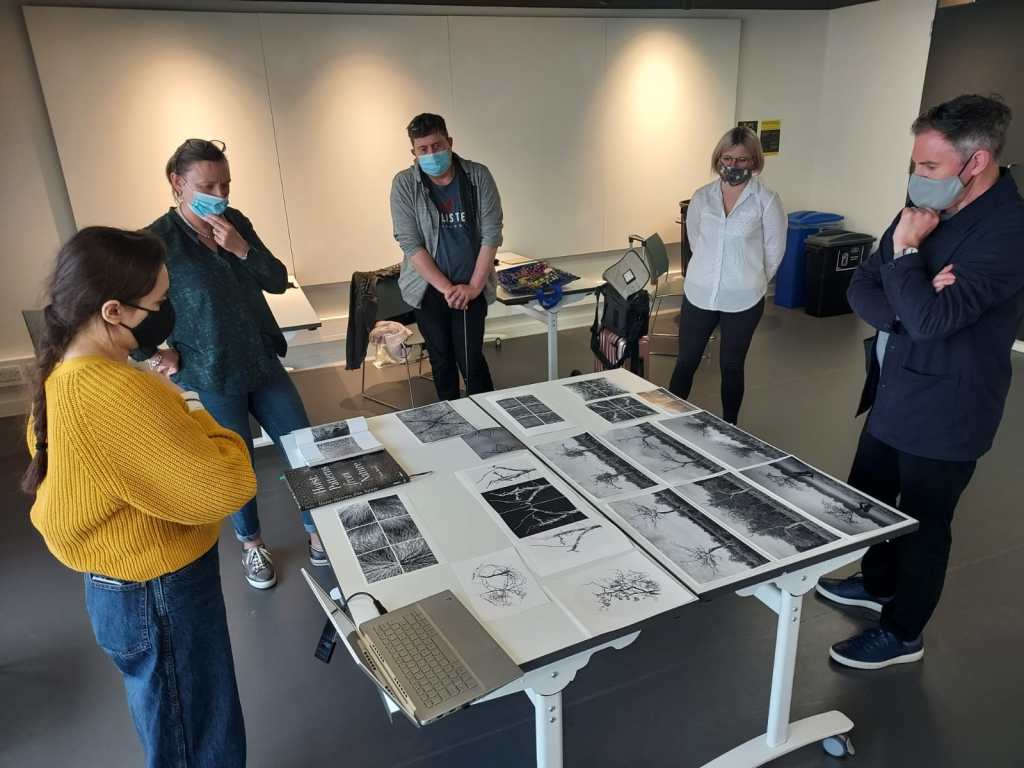
The scheduled session for the afternoon was a set of 1:1 tutorials with the course leader, Fergus Heron. What actually transpired was an inpromptu group tutorial as myself and my four other classmates were able to attend the full session from 2 pm to 5 pm. This was a wonderful opportunity to finally see and discuss our work in person rather than on a screen.
The feedback I received was very encouraging. The following is a summary for my reference and to indicate how to make further progress in forging the work for this module and my final submission pieces.
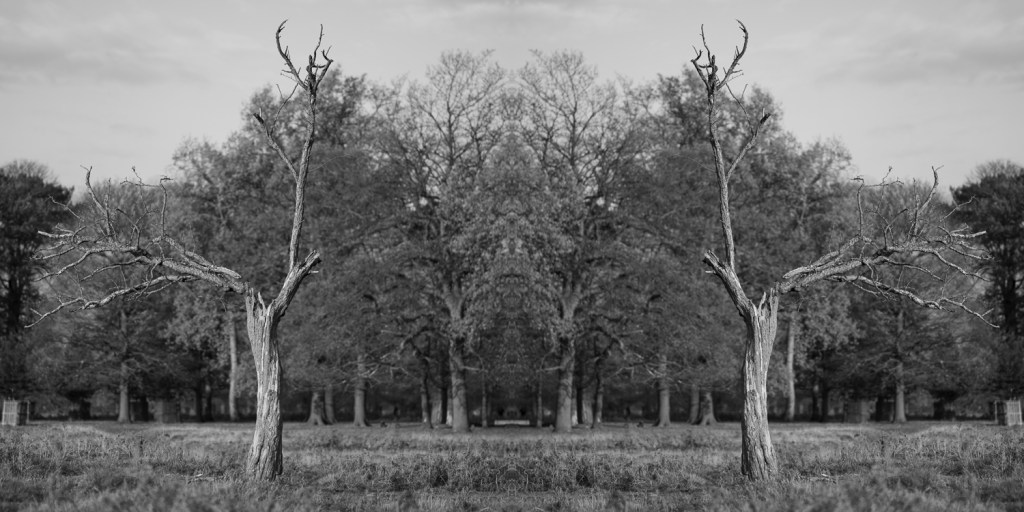
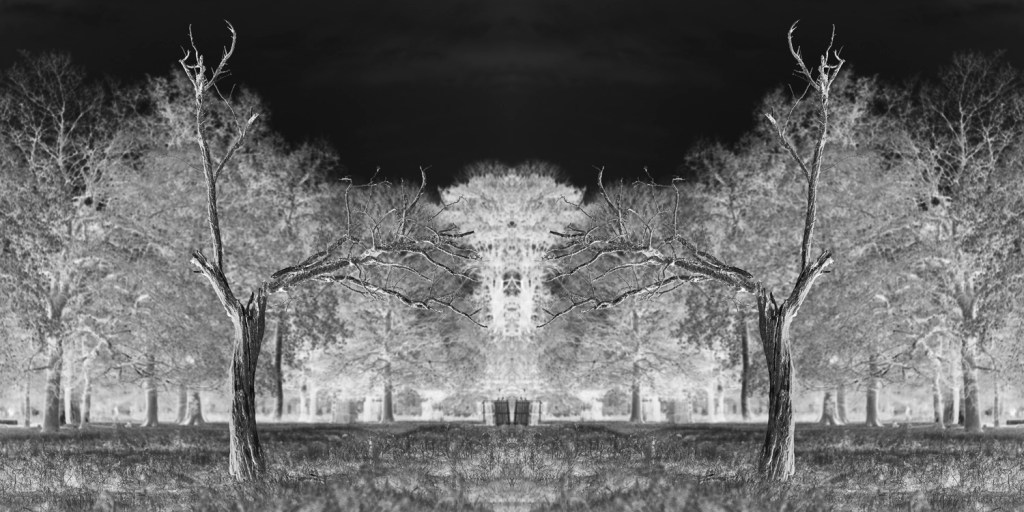
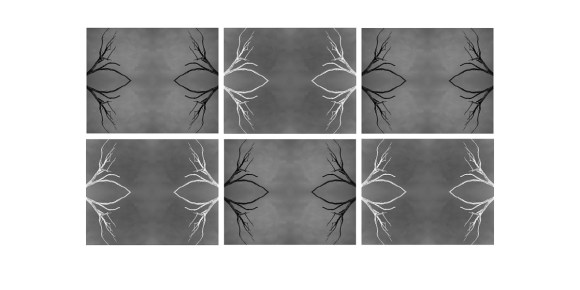
These were thought to be too ‘fussy’ and detailed. I personally like these, but I could try to simplify the configurations.
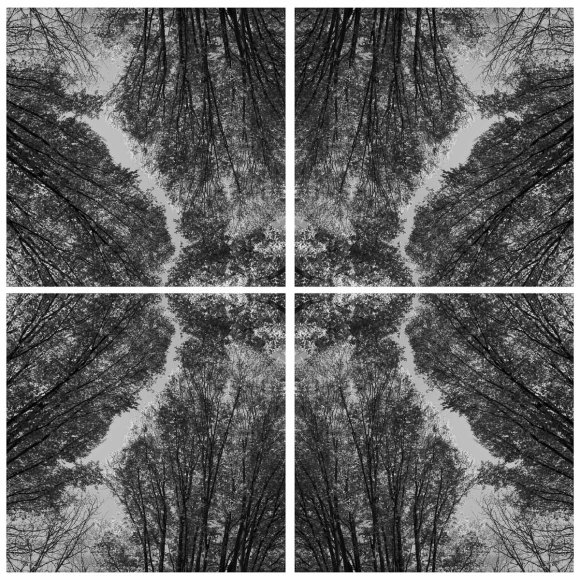
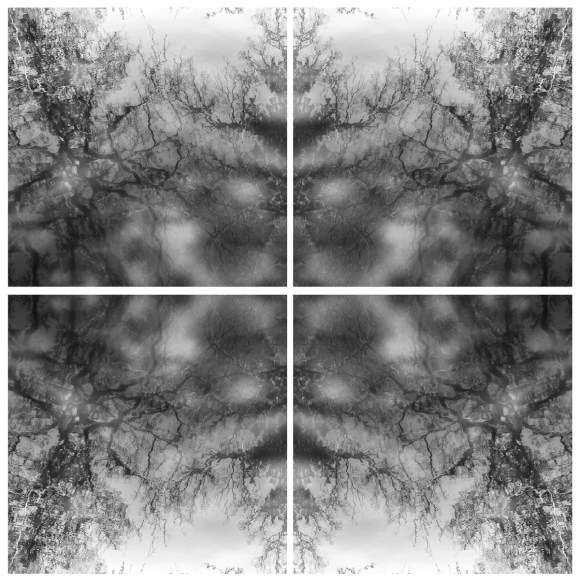
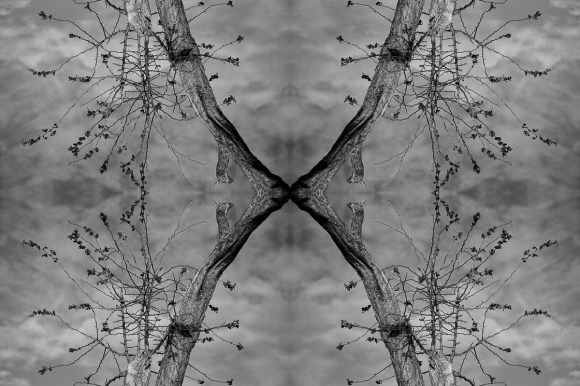
These images were thought of as too ‘literal’. Going forwards, I could experiment with this technique using different subjects.
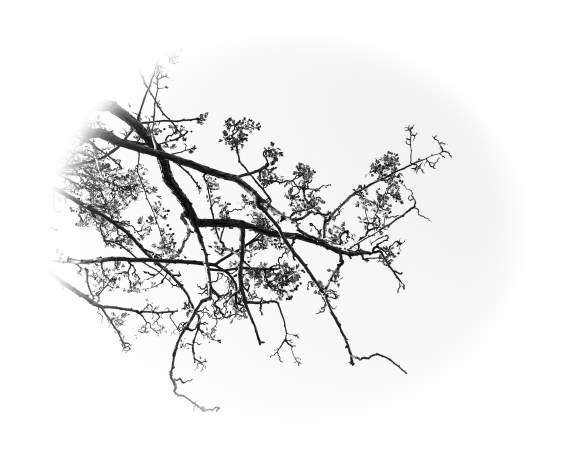
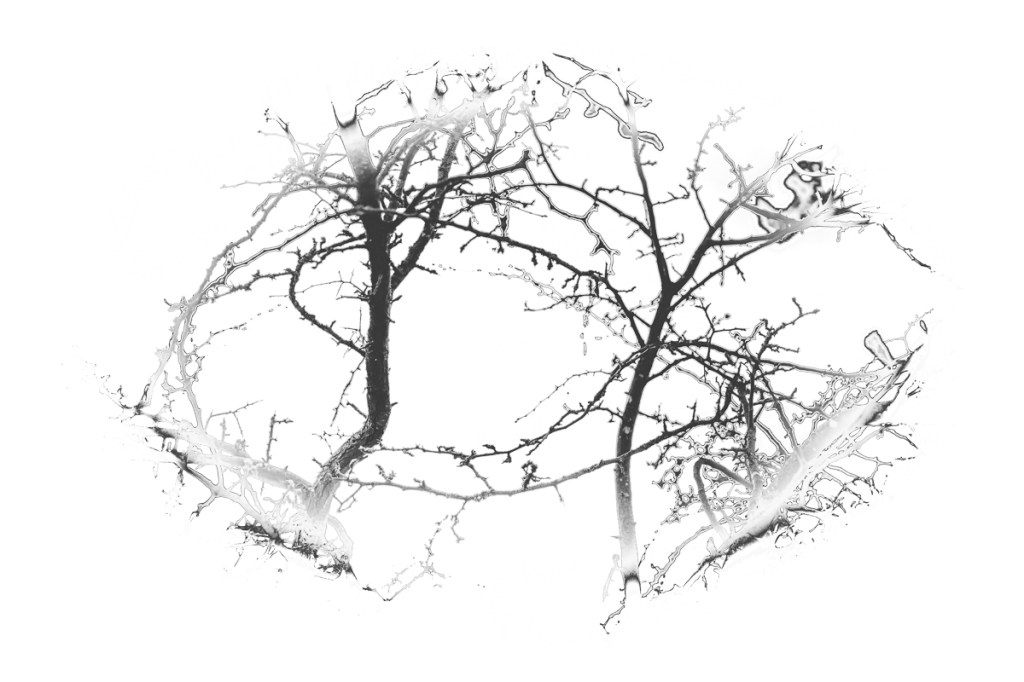
This image was also deemed to have too much detail. However, I liked the comment from two of my classmates as to how it looked like nerve pathways and streaks of lightening. My own opinion on this piece, is that it would need to be printed on large scale to ‘open up’ the spaces between.
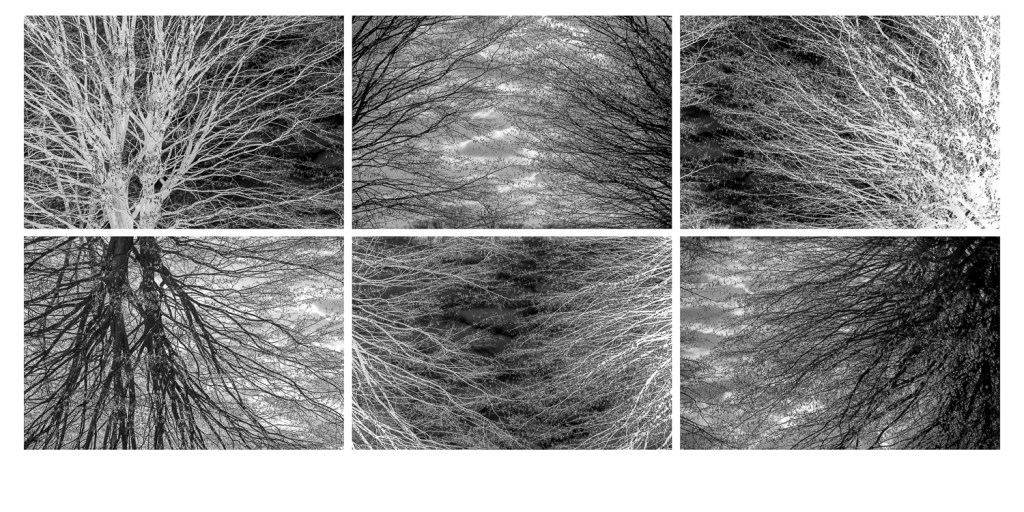
Other images that were considered were the Invisible Trees body of work submitted for AGM62 Photography Research Project: Stage 1. Fergus reiterated how this image has a different ‘feel’ compared to the other five pieces.
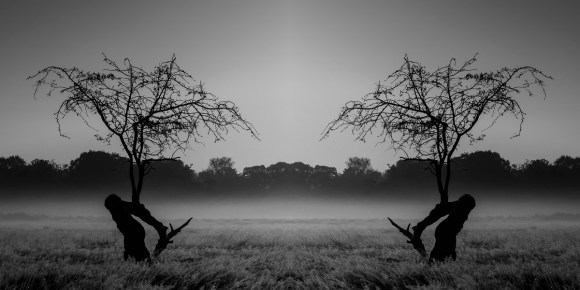
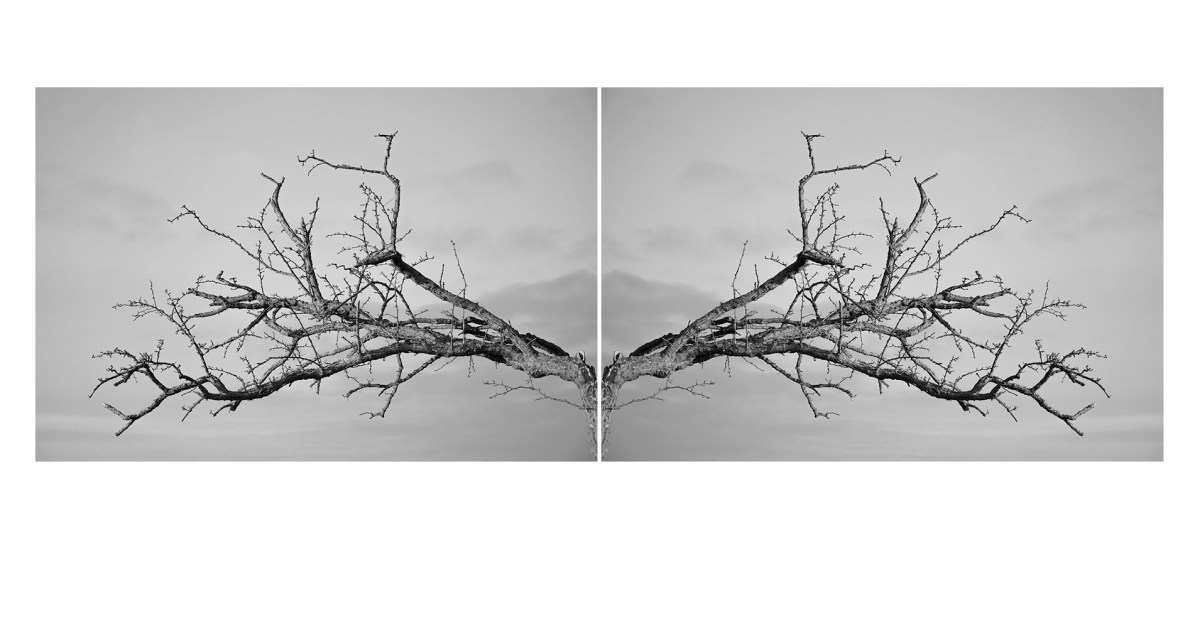
One thought was to break down the images further. By pairing these two, it shows the same tree from the opposing 180 angle. This could play on the ‘positive/negative’ aspect.
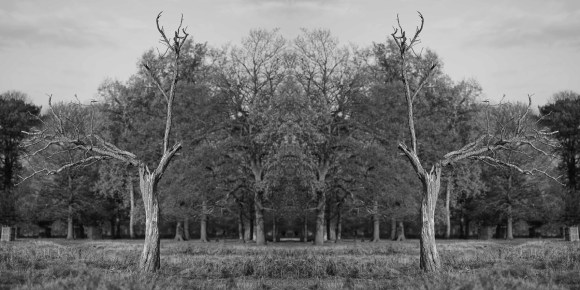
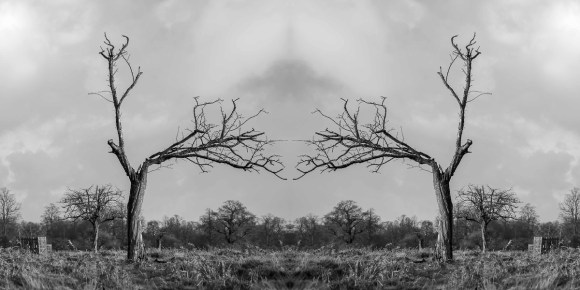
This one was also considered ‘a bit too much’. Simplify?
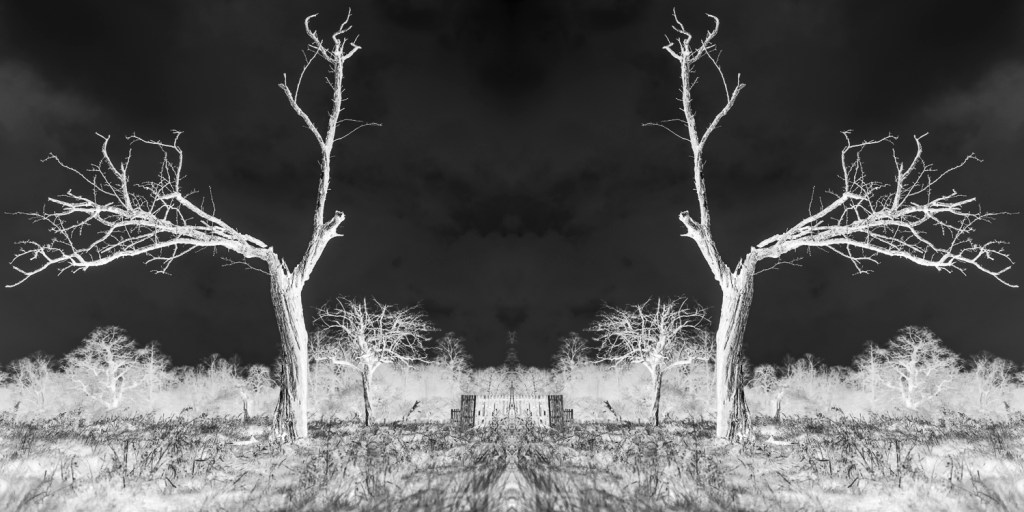
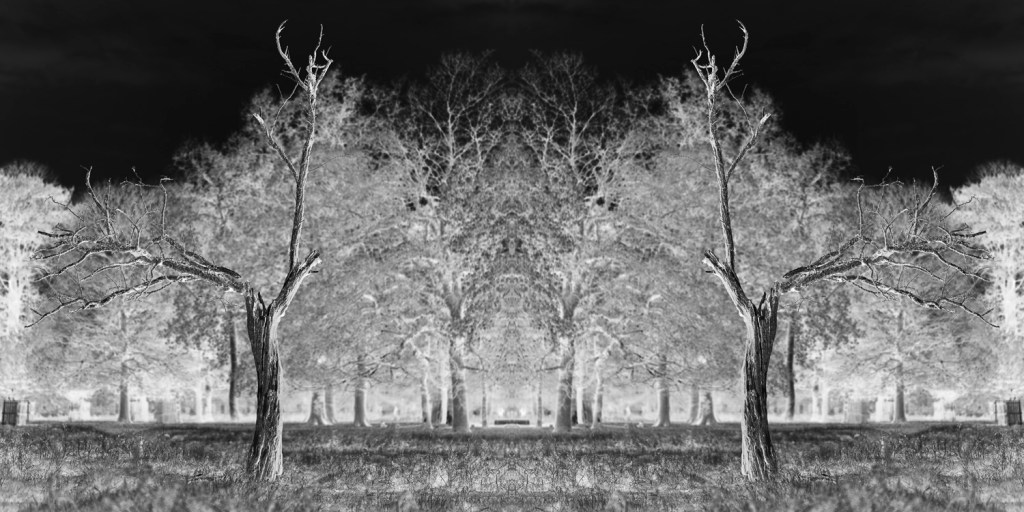
The image that had the most impact on the group was this one:
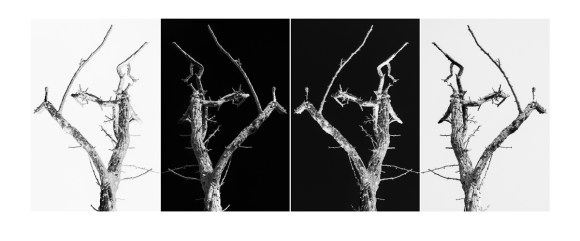
The play on positive/negative was received well and it was thought this configuration and concept could go further.
I will be looking at some of the images I’ve already taken that have similar aspects to the original.
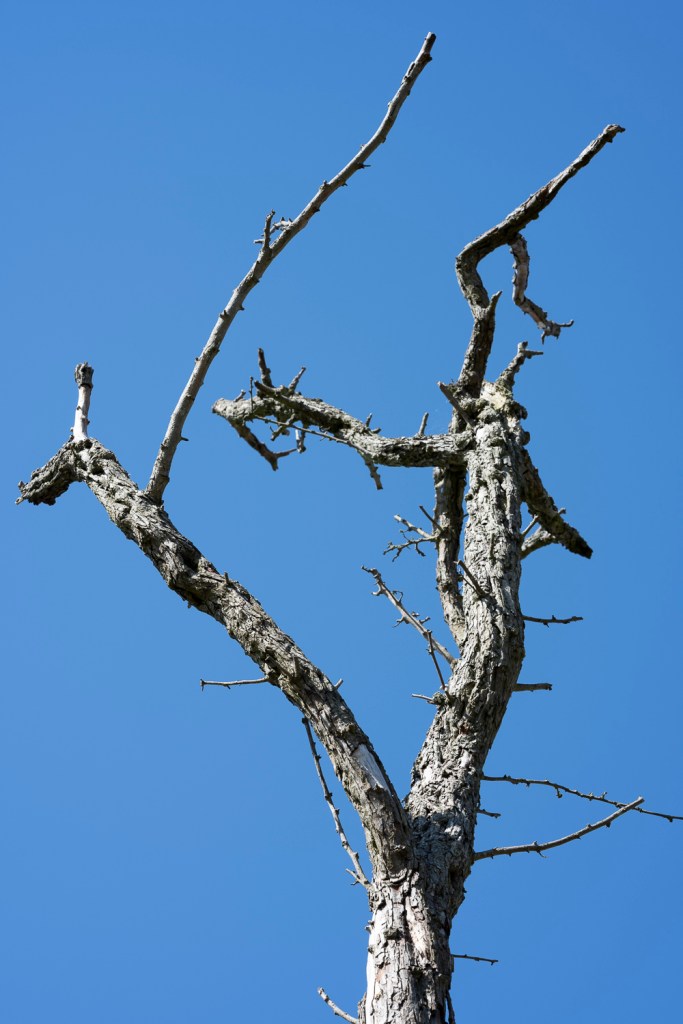
These elements are trees that have an interesting presence with a blue sky background. One comment was that the clouds on the other images were distracting. I think they add a particular atmosphere to these images, but then I love looking at cloud patterns.
One artistic reference to which Fergus pointed out had similarities to this image is George Stubbs’ Whistlejacket. It is a study of a horse, but with no background details. I think this name is quite suited for this image.
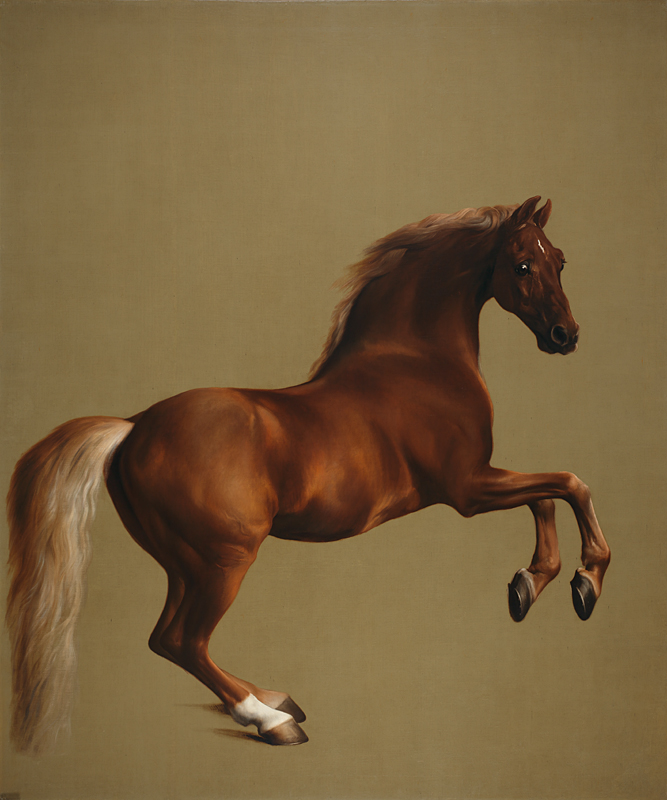
George Stubbs Whistlejacket about 1762 Oil on canvas, 296.1 × 248 cm Bought with the support of the Heritage Lottery Fund, 1997 NG6569 https://www.nationalgallery.org.uk/paintings/NG6569
There were clear lines of further developments and refining that I could follow. My next line of action will be to continue exploring this particular technique and taking it further.
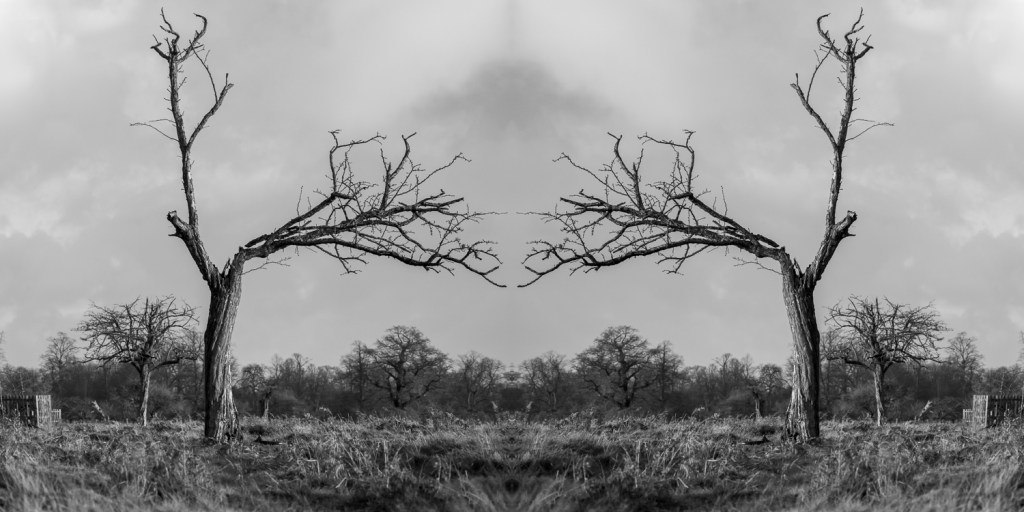
After processing the group’s feedback, I completed the following configuration. I had started this before the day’s session and didn’t show it to the group.
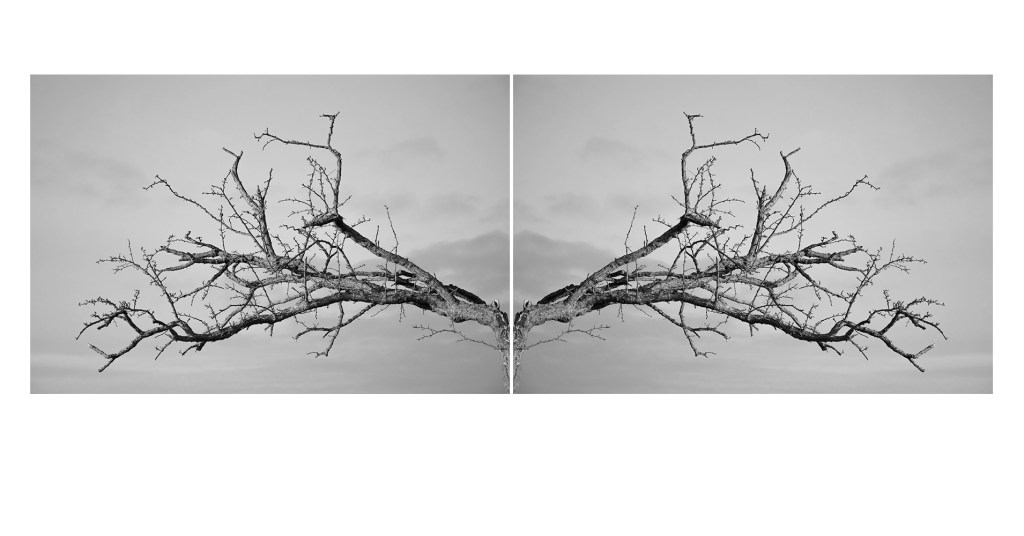
I’ve named this piece Stag.
References
The National Gallery, L., 2021. George Stubbs | Whistlejacket | NG6569 | National Gallery, London. [online] Nationalgallery.org.uk. Available at: <https://www.nationalgallery.org.uk/paintings/george-stubbs-whistlejacket> [Accessed 7 May 2021].
‘So when making a photobook, a photographer would be well advised to spend some time thinking about this: how can I give my book a bit of personality? While there is no single obvious solution to the answer, finding one and then implementing it is so important, especially given there are so many books being made these days.’
(Colberg, 2021)
A selection of photography books and printed matter were brought to the session for discussion.
Design, form, reproduction quality: how they affect discourse and meaning.
Organising and disrupting sequential narratives: linear vs tactical readings.
Multi-sensorial experience: reading, viewing and touch.
The photography book as commodity.
The photography book as a vanity project.
Books to look at:
Suggested Reading
Annabella Pollen, ‘The Book the Nation is Waiting For!’: One Day For Life’. In Patrizia di Bello, Colette Wilson and Shamoon Nazir, The Photobook: From Tablot to Ruscha and Beyond. London, I.B.Tauris, 2012 (p.145-161).
Louise Purbrick, Mining Photography: The Oficina Alianza and Port of Iquique 1899. (To see the images in the album see here: http://tracesofnitrate.org/filter/Nitrate-Geographies/2009-Oficina-Alianza-and-Portof-Iquique-1899)
Joerg Coldberg, ‘Towards a Photobook Taxonomy’, Concientious Photography Magazine, February 2018
Joerg Colberg, ‘The Photobook as Object’, Concientious Photography Magazine, March 2017
Photography Books & Publications
Aglaia Konrad Carrara (2011)
Aglaia Konrad Desert Cities (2008)
Carolina Caycedo, Serpent River Book (2019) http://carolinacaycedo.com/serpent-river-book
Christopher Wool East Brodway Breakdown (2003)
Edmund Clark Negative Publicity (2015)
Eric Tabucchi, Infrasculpture, Revue Blanche Nr 3 (2015)
Felicia Honkasalo, Grey Cobalt (2018)
Gert Van Kesteren Baghdad Calling (2008)
Gonzalo Díaz Lonquén (2012)
Jack Whitefield, Furze (2020)
Jean-Marc Bustamante Tableaux (1994)
Jorge Gronemeyer, Tarjeta Postal (2018)
Juanan Requena Al borde de todo mapa (2016)
Kazuma Obara Silent Histories (2015)
Laia Abril The Epilogue (2014)
Lee Friedlander, The American Monument (1976/2017)
Lewis Baltz Candlestick Point (1989)
Lothar Baumgarten Carbon (1991)
Marianne Bjornmyr Shadows Echoes (2013)
Niels Stomp Mist (2007)
Olafur Eliasson Take Yor Time Vol 3. Driftwood (2010)
Pacifico Silano, I Wish I Never Saw the Sunshine (2014)
Paul Graham In Umbra Res (1990)
Paul Graham The Present (2012)
Roni Horn Island. To Place (10 volumes) 1990-2006
Takashi Homa The Narcissistic City (2016)
Uriel Orlow (et.al.) Soil Affinities, Les Laboratoires d’Aubervilliers/Shelter Press, 2018
Valerio Spada, Gomorrah Girl (2011)
Wassink Lundgren Empty Bottles (2007)
Watabe Yukichi, A Criminal Investigation (2011)
References
Colberg, J., 2021. The Photobook as Object. [online] Conscientious Photography Magazine. Available at: <https://cphmag.com/photobook-object/> [Accessed 4 May 2021].
 Jennie Meadows MA Photography