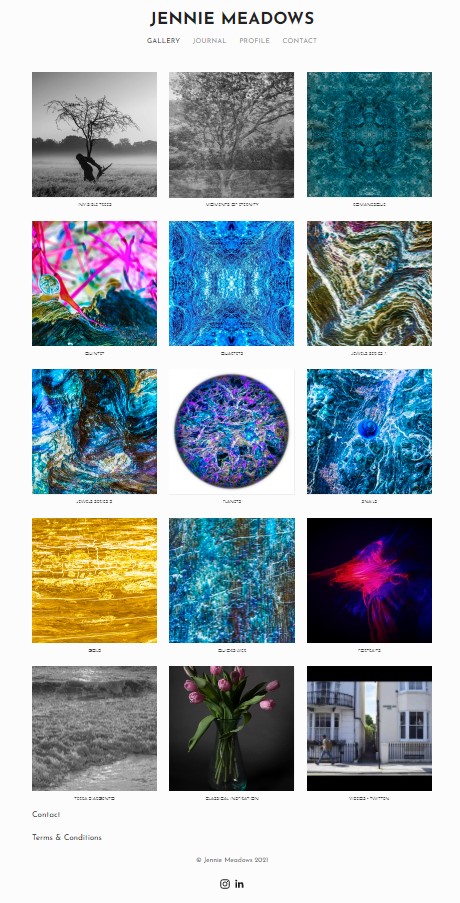
The aim of this tutorial was for Fergus, my tutor, to give feedback on my current online portfolio. At this stage of the module, my portfolio is featured on this website:
The tutorial was scheduled from 2 pm to 2.20 pm. Unfortunately, due to technical issues with internet access, I was only able to speak with Fergus for the final ten minutes. Despite this brief consultation, I was able to gain Fergus’ thoughts and suggestions of the site and any improvements/changes that could be made.
Overall, Fergus thought the site’s appearance to be clear and able to highlight the work without background distractions.
The main criticism was the context of the images and how they refer to the artworks I produce. This is where meaning is ‘lost’ and there needs to be an indisputable definition of what I actually ‘do’. This is an aspect I had already observed, so it was good to hear an affirmitive echo.
As such, I will examine my current collections and write a statement for each one. I also will devise a product range that can be clearly stated on the website.
One frustration I have with the current template is the placing of text on a Gallery page layout.
Not sure how this can be rectified at this stage.
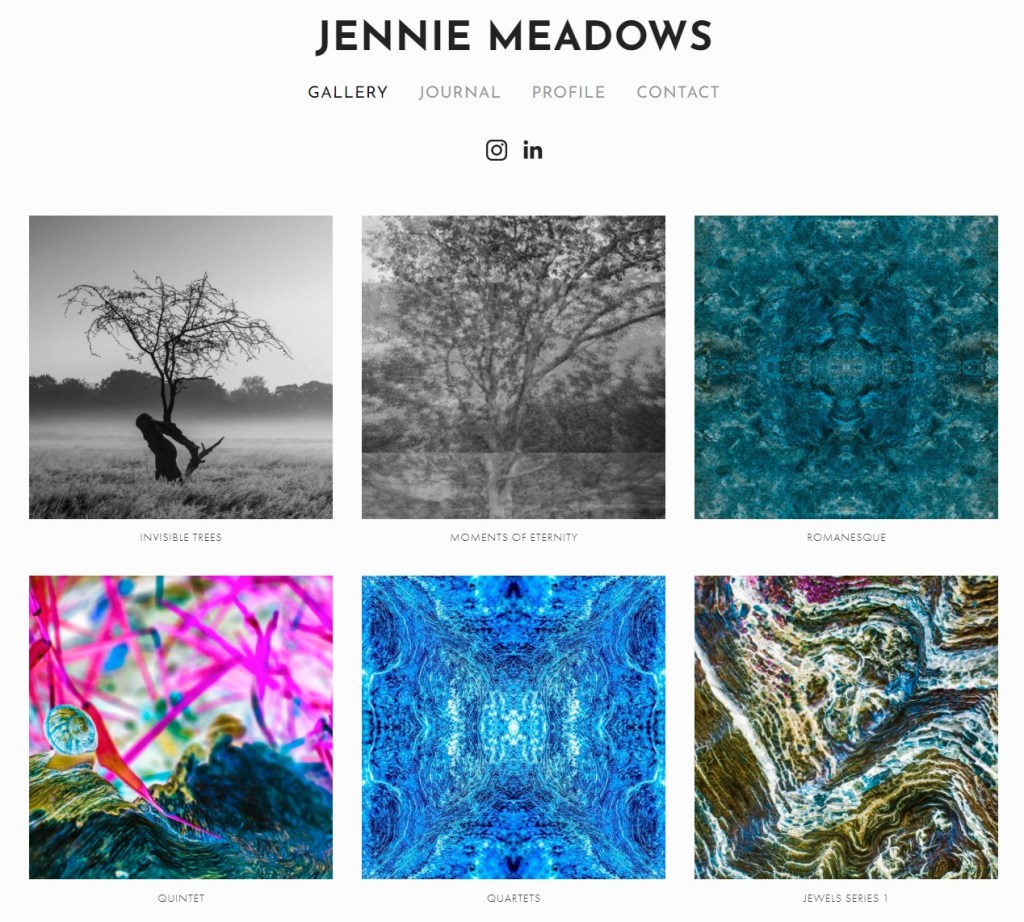
The first action I took was to add the links to my two social media channels (Instagram and LinkedIn) to the header. I realised that as there are quite a few gallery ‘squares’, any visitor to the site has to scroll to the bottom in order to access them. With these at the top, the visitor can just click on the logo to see both feeds.
However, the logos aren’t able to be added universally to the site as I’m using a 7.0 template. I would have to upgrade to a 7.1. Another good reason for updating my website’s template.
In order to help me update my website, I have signed up for a Squarespace course provided by the Royal Photographic Society on 20th May 2021. Hopefully this will assist me in navigating this platforms templates and enable me to concoct the site I envisage.
The following is a guide that was outlined and explained by Eva Bensasson in the art photography website seminar held on 10 March 2021. This is a reference so I can start the process of revising my existing website: http://www.jenniemeadows.com.
At the start of the process, the main questions to ask myself and forumlate an answer to are:
What kind of website suits my practice?
What’s the scale/context of my website?
After this initial work, I will look at other practioners’ websites. This is vital to the process in order to:
Clarify what it is I want to do
Avoid obvious mistakes
As Eva explained, these are the first stages when either creating a new photography-based website or revising my existing one. I need to have in mind the following aspects when doing so:
Consider how the websites are structured and presented.
What choices have been made for the visual layouts, terminology and navigation?
What do I think works well?
What could be improved?
Does the artist have a social media presence and if so how is this incorporated, or not?
Consider who I think this website is aimed at; this may not be obvious, consider what might mark a successful interaction e.g. reaching a certain page, downloading a pdf, dwell time, a commercial transaction.
Elements to look at are:
Structure
Style
Wording
Ask myself the following questions:
How is the work represented?
Consider the relationship of text to image, does one overshadow the other?
How is the meta-information about the images presented in each case?
Where the photograph/artwork exists as a physical object, how is this physicality communicated?
Cross-platform?How do all these websites perform on phones and tablets? Over half of your visitors may be viewing my site from one of these platforms yet so many of the sites below are not responsive.
URLs Look at the web addresses above. What are the patterns in the names and domains chosen?
How is the home page structured / what’s on it? Examples for discussion:
What navigation (functionality, structure, wording, terminology – how much is there)? See also how bodies of photographic practice are presented (as series, within ‘work’, from the front page…). Examples for discussion:
Look at the journey from site to social media account, and vice versa. The list of social profiles could easily have been as long as this list of portfolio websites. The few below are for the purpose of starting discussion.
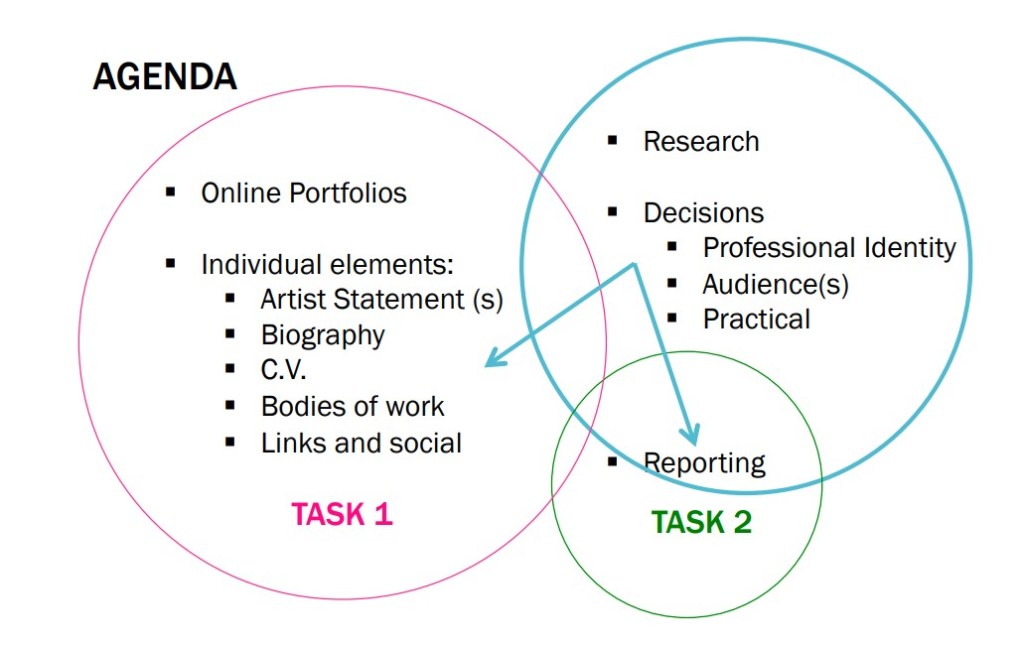
During the session on 3 March 2021 our tutor, Rachel, went through a presentation outlining the two tasks for the module. The following is an adaptation of that presentation for my reference.
Note to self – examples of other photographer’s websites and elements to be considered for this module are featured within the original presentation.
Task 1
A Professional Portfolio presented on a website to include as appropriate elements from among the following:
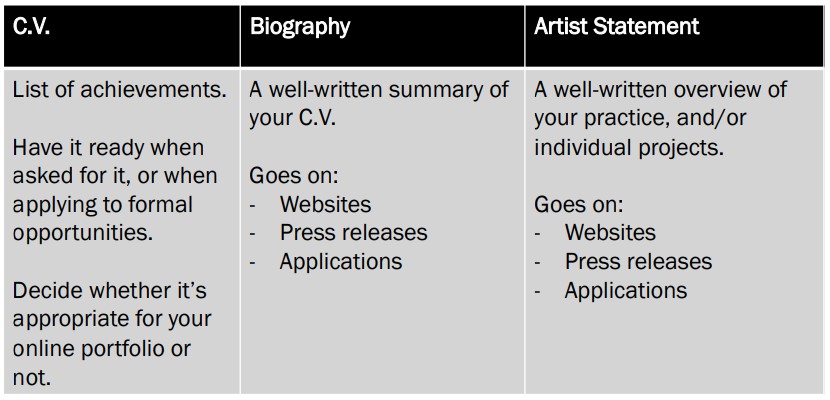
Artist’s statement
Biography
C.V.
Bodies of photographic work appropriately captioned or annotated
Textual information on any relevant technical details and material qualities of work
Any relevant web links to social media use, exhibitions or publications as appropriate
80% (LO2, LO4)
Task 2
A report on the online portfolio articulating the professional strategy, principles underlying the organisation of the material, the design and intended audience (1500 words).
20% (LO1, LO3)
The following diagram highlights how the two tasks work in relation to each other.
Online Portfolios
There is no doubt that it an industry standard to be able to be ‘found’ online, but this can take different forms (including multiple platforms, such as static/social/represented.). There are many different ways to showcase my work online.
In general, online portfolios are types of websites, and they can be realised in different ways according to:
My current online presence is through my website: http://www.jenniemeadows.com. This was set up in 2016 and the details of its creation and realisation can be read here:
I will revisit these details then analyse my site to see how it can be improved after the following sessions.
10 March 2021 2pm – 5pm: Eva Bensasson – Websites for Photographic Practices
Research / Scoping the Field
Planning your website
17 March 2021 2pm to 5pm: Seán Birnie – Building Websites using Online Platforms
Introduction to easy-to-use options for building a site
Practical overview on how they work
This will be covered in a separate post (add link when done).
First Thoughts
My website is my representation when I cannot be there. It is a projection of ‘me’.
Be professional and act professionally.
What is the purpose of my website? (this will inform decisions on every element.)
Is it to:
Showcase your work?
Sell your work?
Offer other services (teaching, writing, assisting etc.)
At the time of writing, the purpose of my website is to showcase my work. I will not be actively selling my work through my website at this time. However, I will be considering my platform options to do this in the future. With my current website platform provider, Squarespace, there is an option to have direct sales. The other option is to sell through sales platforms, including Etsy and Saatchi Art.
Website Elements – Artist Statement
An artist statement is a description of myself as an artist/my practice.
The statement stands in for me when I can’t be there
An artist statement can also be a description of a specific body of work.
This statement stands in for me, talking about the work, when I can’t be there.
My online portfolio may contain a mix of both types.
Artist Statement Tips
The following is in relation to the mistakes I should avoid when applying to a photography grant, as advised by Photographic Museum of Humanity but can also apply to writing an Artist Statement.
When well written, an Artist Statement should show self-confidence and that I own my creative work. This will help viewers to engage with it and understand my perspective. I want the statement to be clear, accurate and synthetic.
Divide the text into clear paragraphs and start with a strong introduction. Always have a second pair of eyes to proofread your statement. You could also try a free app like Grammarly.
Artist Statements are:
Clear
Meaningful
Descriptive
Accurate
Fairly concise (150-500words)
Style:
Be honest
Try to capture my own speaking voice
Avoid repetition of phrases and words
Look for sentences that say the same thing I said before, but in a different way – choose the better of the two.
Vary sentence structure and length
The length of a sentence should relate to the complexity of the idea.
Organisation of detail is important – significant ideas should be at the end of each sentence for emphasis
Artist Statements can include:
Aims
Themes, concepts
Media and Materials
Processes
Rationale (of above)
Key Influences
Ask myself:
What am I trying to say in the work?
What influences my work?
How do my methods of working (techniques, style, formal decisions) support the content of my work?”
What are specific examples of this in my work?
Does this statement conjure up any images?
Artist Statements DO NOT include:
Biographical information
C.V. information
Contact information
Jargon
An Artist Statement is NOT:
A press release
Poetry or prose
Anecdotal
“Here are a few things an artist statement is NOT: a manifesto, an art history lecture, a story about discovering art, short fiction, self-psychoanalysis, a string of adjectives, a grand theory of everything you’ve ever made, or a list of your career accomplishments…” (Francis Hodgson)
Artist Statement – Getting Started
Possible strategies:
Start with a list of adjectives
Record a conversation of you talking about your work to another person
Write a letter (you never have to send it!) explaining our work to your family/friend/other
It’s always easier to edit something that exists than start something new – so write something/anything and then revise it
Biography / C.V. / Artist Statement These elements tend to get grouped under one place on a website
ABOUT CONTACT BIO/C.V.
Bodies of Work
I need to work out how they might operate together.
One of the key parts of my online portfolio is to showcase my visual work.
It is common to group images for coherence.
This could be by project
It could be by theme (portraits, landscapes, commercial, fine art …etc.
I also need to decide how many images is appropriate for MY website.
e.g. Is a handful of representative images from a project, or most of them?
Bodies of Work’s Organisation
I must consider how other organise this part of their website:
Is there a menu item for each project?
Are projects/bodies of work curated under main headings?
A very practical thing to consider here might be how much work I have
What do I want to include?
What do I want to exclude?
Which images best serve my purpose of showcasing my work and my ability as a photographer/artist?
Image Annotation
Images should be annotated – elements of description include:
Name of the work
Date of creation
If relevant:
Name of the series it’s from
Materials/Duration
Size
Framing
Price
Edition
Other important information:
Name of author
Copyright assertions
For the purpose of my website, the above could be situated on the website somewhere to cover all images, which may be more appropriate than adding them to each image. (But it’s up to me).
Links & Social Media
It can be important to consider how my website/online portfolio works in the larger context of my other online media and platforms.
What information flows to my website, and out from, my website?
Consider use of Instagram, Twitter, Facebook, LinkedIn, Blogs, Specific exhibitions/other gallery websites, Source Graduate Online, mailing lists.
What’s the key use of each, and how might they augment my online profile overall?
I currently have a link to my Instagram account, on which I post finalised images and work-in-progress. I also post location images and if there is of anything of interest I want to share with my followers. I also have a LinkedIn profile. I also post occasional blog posts on my website that I share to Instagram (via my profile) and my LinkedIn feed.
I have recently read the chapter within Navigating the Art World: Professional Practice for the Early Career Artist that focuses on how to capture an audience by effectively using social media. The notes from this chapter can be accessed here:
What part of my professional self is this website representing?
Artist
Academic
Commercial
Mixture of above?
Who is the main audience? (who are additional audiences?)
Galleries
Funders
Employers
Decisions To Be Made
Which elements to include on my website.
Individual decisions about each part as relevant (bio, statement, C.V.)
How to organise your information, including:
Menu items (and naming)
Bodies of work
Text
Links
Report Writing
My report communicates what my online portfolio comprises of and explains the decisions, and decision-making processes that led to its creation.
I might include:
Description of my professional identity
My aims for the online portfolio
Relevant research
Decisions on individual elements
Decisions made on layout and design
Critical evaluation
Timeline Highlights
10 March 2021 2pm – 5pm: Eva Bensasson – Websites for Photographic Practices
Research / Scoping the Field
Planning your website
Actions Before Session:
Decide on my aim for portfolio/website Bring Questions!
17 March 2021 2pm to 5pm: Seán Birnie – Building Websites using Online Platforms
Introduction to easy-to-use options for building a site
Practical overview on how they work
Actions Before Session:
Bring some elements to test – bio/artist statement/images
26 April 2021 2pm to 5pm: Rachel Gillies and Fergus Heron – 1:1 Tutorials
Opportunity to present draft elements of website/report
Advice and feedback given
Actions Before Session:
Have draft website for discussion – the more I have, the more feedback I’ll get.
References
2020. ‘Effective Social Media – How to Capture Your Audience‘ in Navigating the Art World: Professional Practice for the Early Career Artist (2nd Edition). Delphian Gallery: London. pp.34-41.
The following are notes taken from ‘Effective Social Media – How to capture your audience’ in Navigating the Art World: Professional Practice for the Early Career Artist (2nd Edition). Delphian Gallery: London. pp.34-41.
This reading was in preparation for the session planned for 17 Februrary 2021 and will contribute in completing my tasks for the AGM59 Professional Development for Photographic Independent Practice.
The following covers advice on the effective use of social media, websites and blogs in relation to this.
Instagram
At the time of this project, the most useful platform for emerging artists is Instagram. I already use this platform
Types of Feed
Two types of Instagram feed:
Visual Diary Approach
Gallery Approach
Visual Diary Approach
Treats my feed like a journal or online sketchbook
Personal – appeals to collectors and patrons who want to know more about my personality before they decide to invest
Good feed to utilise if I am hoping to attract galleries and curators (these contacts want to look both at my work AND a little more information about me as a person:
Interests
Inspirations
Methods of working
Works in progress
Visual Diary approach is conducive to:
Garnering more genuine engagement
Promoting actual discussion within comments
May not generate as much overall engagement as the Gallery Approach, but is much more likely to create genuine connections with my fanbase, both between me and my fans and between fans and other fans
People are more likely to comment encouragement and critique on posts using a Visual Diary Approach
Good for displaying more of my personality
Share insecurities and failures as well as my triumphs
Humanises me
Helps my supporters feel they know the ‘real’ me
Makes fans and collectors invest in the artist, not just the artwork
Captions and responses to comments can be a lot more informal and conversational
These are nicer to write and nicer to read
Gallery Approach
In contrast to the Visual Diary Approach, a Gallery one:
Shows very little personality in favour of expertly taken images of works on pristine white gallery-like walls.
Captions are often formal and written in the third person
Artist’s voice largely absent
Gallery account is successful when the artist is already established and doesn’t want/need direct connection with supporters
Good for practitioners, such as:
Commercial photographers
Commercial illustrators
Commercial designers
Learning about the personality of the artist is less important for commissioning editors or art directors
Getting the job done to spec is more essential to these roles than knowing the artist’s personality (in my personal experience)
Conclusion?
Both approaches can be useful for different reasons
Good to spend some time deciding which one suits me and what I want
Can run both in parallel, especially when more established (my thought)
Driving Engagement
Engagement must be genuine.
What I want is (ideally in this order):
Comments
Reposts
Direct messages
Likes
Notes on Comments
I want comments on my posts that go beyond the ubiquitous ‘great work’ and give something more ‘human’
Any comments will help drive overall engagement
Actual conversation within the comments is more useful
‘Like’ comments my photos receive
Respond to the comments
Has taken commenter valuable time to make a comment
Nice for the commenter to see that their act has been noticed
Helps drive engagement to their account
Social media is SOCIAL
The more I engage with people (both on their accounts and on my own one/s) the more they will engage with me in turn
By encouraging engagement on my own account, I should be giving what I hope to receive across other people’s accounts, too
I should comment upon works I love and say why I love them
Don’t stick to the ubiquitous single word affirmations or banal ‘thumbs up’ emojis
Don’t offer critique, unless requested, or appear to be derisory
Notes on Sharing
Some of the most successful accounts that the writers of this book know of post their own work as often as sharing the work of others
May seem counterintuitive, but it pays dividends
Account that share other’s work are more varied, therefore more widely appealing
Important to share images that won’t look out of place on my feed
When done well, these additions can benefit the whole
Becomes greater than the sum of its parts
Can be done in either posts or stories
Both are good for different reasons:
Stories: temporary and immediate and free of the negative effects of the selective algorithm that can affect how my feed is seen by others
When sharing a work to a story, tag the artist always so they know I’ve posted it
By promoting dialogue between me and other artists, it creates the potential for them to further share my profile through reposts
Personally, I would share other’s work in stories as the images of other’s would dilute my feed
Capturing My Audience
What can I do with my audience once I have them? Bring them from my social media to ‘something closer to home’
In an ideal world, that would be to visit my shows and buy my work, but this happens in the physical world
Often needs to one or two more steps in between this and discovering me online
Website & Blog
These platforms and methods of communicating are essential in bridging the gap between being visible and discovered on social media and the desired outcome of people visiting my shows and/or buying my work
Incredibly useful tool in giving potentially interested parties more information about myself and my practice and bringing them in closer
A website serves many functions that are absent from my social media
A well-ordered website is essential, and the most efficient use of the site would be to include a blog
This blog, when used effectively, can help drive traffic towards social media and vice-versa
Keywords and an effective SEO (search engine optimisation) approach is useful to optimise how the blog performs online
Ideal blog would be updated as often as is possible and contain more text than images
The blog can be used to provide further insight into my practice and/or inspirations
Optimum use of a website/blog can work for my online presence (in terms of SEO and being ‘searchable’
This optimum use can also supplement my social media
Content that I present should be specific to each medium (main website, blog and social media)
Each has different strengths and weaknesses:
Website:
Main website should contain all details:
Personal statement
CV
List of other engagements (shows I been in and other relevant information)
Images on website should be the high-resolution photos of finished works, shown either cropped to only include the work or in an interesting setting – think of it as a retrospective show and only include my absolute best work
Blog:
A bit more informal
Contain a lot more text
Talk about things as they are in progress
Can link to my social media
Where appropriate, build upon or give more details to things I have posted there
Social Media:
Use as outlined above
Website, blog, and social media should be used in synch direct traffic between them
Mailing List
Can bring my social media following into my mailing list
Can ‘future proof’ if Instagram or alternative social media platforms become defunct or change
When done correctly, can be the lifeblood of my business
Encourage my followers to be on my mailing list
Whenever anyone buys or expresses an interest in my work, put all my details in a spreadsheet to keep a record
Gives me a bank of people who I can be certain have a tangible interest in my work
Whenever I release a new print or start planning a new show, these are the most likely people to be interested
Ways to get people to sign up to my mailing list include using:
Swipe-up functionality within stories
Adding my signup address in my bio
Mentioning my mailing list in my captions
Mailing list sign up box can appear as a pop up on my website
Can also remain permanently in a side bar on my website
Make sure I am GDR compliant!
All those on my mailing list have in some way consented to be contacted by me
When people unsubscribe, don’t be disheartened – think of it as part of honing a tight, dedicated list that has a genuine interest in what I am doing
Optimise the open rates of my mailing list using techniques such as personalising the ‘To’ field of my message, verifying my email and authenticating my domain
Is fiddly, but they will really help me ensure my messages do not get redirected to junk by spam filters
Conclusion
My social media shouldn’t be treated as a business tool
When used appropriately, can be of great benefit to me
Treat it with the respect it deserves
Get the best out of Instagram while it is around
Social media may change, but don’t fear this aspect
Adopt, adapt to, and utilise whatever new media is available in the most efficient way possible
Using social media in the most efficient way is to bring any followers I attain closer into that fold and create a like-minded community
Once I have this community, I should strive to extend that community BEYOND the confines of whatever platform I found them on and towards other more stable platforms, like email
In addition to this very useful advice, the following observations and advice supplied by Artquest should be taken into consideration:
2020. ‘Effective Social Media – How to Capture Your Audience‘ in Navigating the Art World: Professional Practice for the Early Career Artist (2nd Edition). Delphian Gallery: London. pp.34-41.
 Jennie Meadows MA Photography