After four weeks of spring break, the class and tutors had an online seminar from 10am to 1pm.
During the seminar myself and my fellow students presented the results of their projects so far and discussed the contextualisation of our projects. This was both specifically in relation to relevant photographic issues and debates (both contemporary and historical) and in relation to fields outside of photography. Each of us also explained how their chosen references had informed their projects and helped to propel it forwards.
This was a very positive session and great to see everybody’s work and get a better understanding of the ethos and concepts behind it. It was also a relief to get some feedback from my contemporaries and tutors. Having worked in my own ‘bubble’ for since 31 March, it was affirming that my work wasn’t in vain and I was on the right track.
To help further my research, the following areas of research and experimentation were suggested and I will be exploring these further:
Subject Matter
With regard to what I presented, the images and concepts that elicited the best and strongest response was that of the multiple exposure shots of the trees.
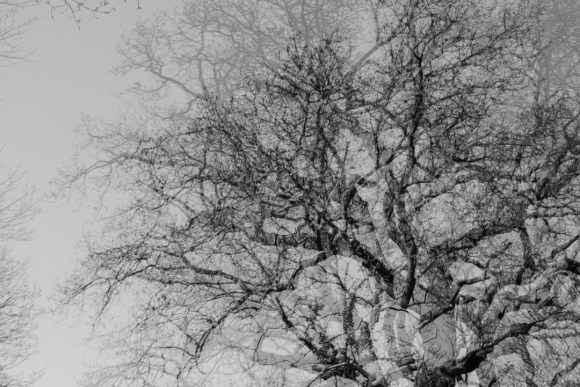
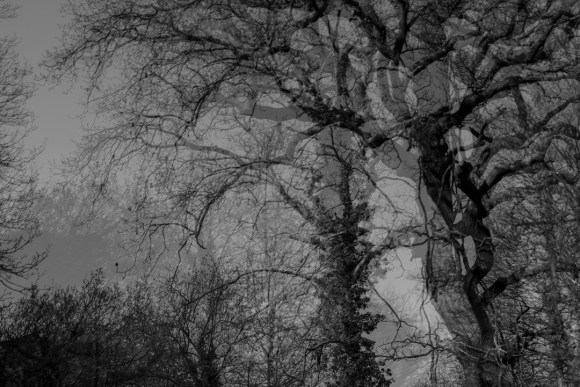
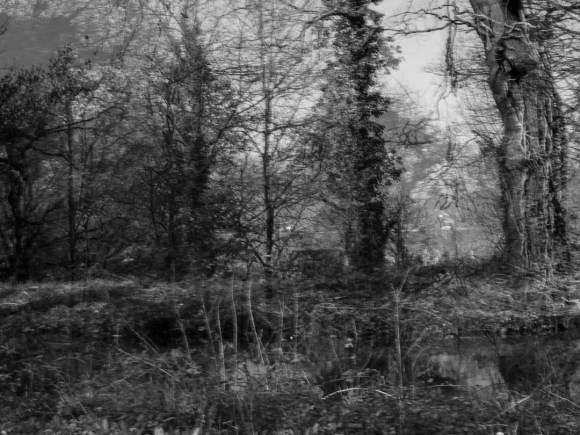
These, combined with the references I also presented, were confirmed to be a solid foundation from which to expand my research and experimentation.
Technically, I knew I then had to refine my approach in both taking the images and the editing process. The images need to be captured with a more sophisticated and polished methodology and approach. For example, using a tripod rather than taking shots ‘freehand’. I also need to investigate and make the most of my camera’s multiple-exposure mode.
Other areas of expansion were:
Simon Roberts
Fergus (module tutor) suggested looking at the work of the artist-photographer, Simon Roberts (https://www.simoncroberts.com/). Roberts had an exhibition at Pallant House in Chichester from 29 June to 13 October 2019.
Called ‘Inscapes’, this is a series of photographic, video and sound-based landscape studies that questions how connected are we to our local landscapes and how can an essence of a place be captured? There was more to explore online through the Pallant House’s website: https://pallant.org.uk/whats-on/simon-roberts-inscapes/.
The influence behind Roberts’ work was the paintings of British artist, Ivon Hitchens. Another lead to follow: https://www.tate.org.uk/art/artists/ivon-hitchens-1291
There was a particular journal piece recommended by both Fergus and Sofia: The Magic in the Mundane. I made a note that it was available on both the University of Brighton online library and on the Tate website, but couldn’t initially find it. At the time of writing, I sent an email to the group to see if they could point me in the right direction.
The Camden Group
Another reference was The Camden Group who introduced Post-Impressionism to Britain, inspired by the work of van Gough and Gaugin on the continent. According to Sofia, the painters in this group used to regularly go to the local London parks and paint. Apprently, one of these individual’s demise was through tuberculosis from being out in the rain while doing so.
https://www.tate.org.uk/whats-on/tate-britain/exhibition/modern-painters-camden-town-group
https://www.tate.org.uk/whats-on/tate-britain/exhibition/modern-painters-camden-town-group
https://www.tate.org.uk/context-comment/audio/lives-and-letters-camden-town-group
Helen Sear
Another artist reference recommended by Fergus was Helen Sear: https://www.helensear.com/. After looking at Sear’s website, I realised that I had seen her work before. It is very beautiful and some images are absolutely exquisite. I will be researching Sear’s work and methodology further to see how it resonates and can inform my own practice.
Martin Seeds
Again, this was another photographer recommended by Fergus and, again, another photographer whose work I was previously aware.
Having looked at Seeds website, his body of work ‘Assembly’ is one to look at in more detail: https://martinseeds.com/assembly
Tacita Dean – Majesty
One element of the tree grids that was brought up was removing the ‘white space’ between the connecting images and presenting them as ‘flush’. Abi suggested looking at Tacita Dean’s work, Majesty.
https://www.tate.org.uk/art/artworks/dean-majesty-t12805
In addition, I will be looking at Dean’s work with regards to trees and the way she presents large-scale pieces. This was marked as a research source before the seminar and on my list of ‘things-to-do’.
Robert Smithson – Incidents of Mirror
This name and work were also mentioned by Fergus. On first glimpse, it again seemed very relevant and I will look into this in more detail.
Presentation
In addition to not having spaces between the individual images, their final size came into question. Xavier mentioned the possible issues of having large single images printed. I know from both research and experience that with the quality of RAW and the resulting TIFF files for printing these images will be of high resolution. At 6000 x 4000 pixels, this means a single printed image could be 20″ x 13.3″ if printed at 300 dpi. I also know that a high quality image can be printed at a lower resolution (around 240dpi), which would mean an image printed at 25″ x 16.6″.
There are also other print methods that can produce work on a large scale without losing integrity and I will have to check with my go-to print bureaus to see what is (and/or isn’t) possible. I will also have to research various printing substrates and framing/hanging options with both price and practicality in mind.
Content and Composition
A very pertinent observation of Fergus is how, although the individual images of the tree are shot in ‘landscape’, when combined they create a ‘portrait’ composition. This lead to the direction of tree portraits. This line of enquiry and research could bring into question how is an individual tree portrayed through the conventions of portrait photography rather than those of landscape. At this stage in the project, further exploration and experimentation is essential.
Books
Xavier recommended How Forests Think: Toward an Anthropology Beyond The Human by Edward Kohn. I ordered the book on 29 April and waiting for its arrival at the time of writing this post.
This book explores the concept of the tree as a non-human sentient being – something I believe in myself. It will be interesting to see how Kohn approaches this subject.
The other book I need to read in more detail is The Hidden Life of Trees by Peter Wohlleben. I originally discovered this tome when it was first published in 2016 and have had the intention to read it since. Luckily, my flatmate ordered a copy after I told him about it, so I have no excuse not to, now!
Paper
The final reference I was given was the paper The Discourse of Perspective in the Twentieth Century: Panofsky, Damisch, Lacan by Margaret Iversen. This was thought to be of use by Fergus and Sofia. I downloaded and printed this paper with the intention of reading it in relation to this project.
The Discourse of Perspective in the Twentieth Century: Panofsky, Damisch, Lacan
Author(s): Margaret Iversen
Source: Oxford Art Journal, Vol. 28, No. 2 (2005), pp. 193-202
Published by: Oxford University Press
Stable URL: https://www.jstor.org/stable/4500016
As I knew it would be, this seminar and the resulting information was an essential and inspiring part of the process. I was very appreciative of every snippet shared and felt more informed and confident in how everything was progressing.
 Jennie Meadows MA Photography