For the seminar on Tuesday 17th March, the class was tasked to identify a current exhibition, upcoming artist-talk or event or potential interviewee that each student felt was pertinent to their own project. We would then need to bring to the session a short summary of the chosen influence. I had to be prepared to discuss how I think that I could engage with this in a way that makes it specifically useful, productive and relevant to my own research and practice.
As I had started on a particular line of research focusing on surrealism, I was pleased to discover that the Dulwich Picture Library was currently holding a relevant exhibition. According to the gallery’s website (shown below), this major exhibition marked 100 years since the birth of surrealism, championing the British artists that contributed to an iconic movement.
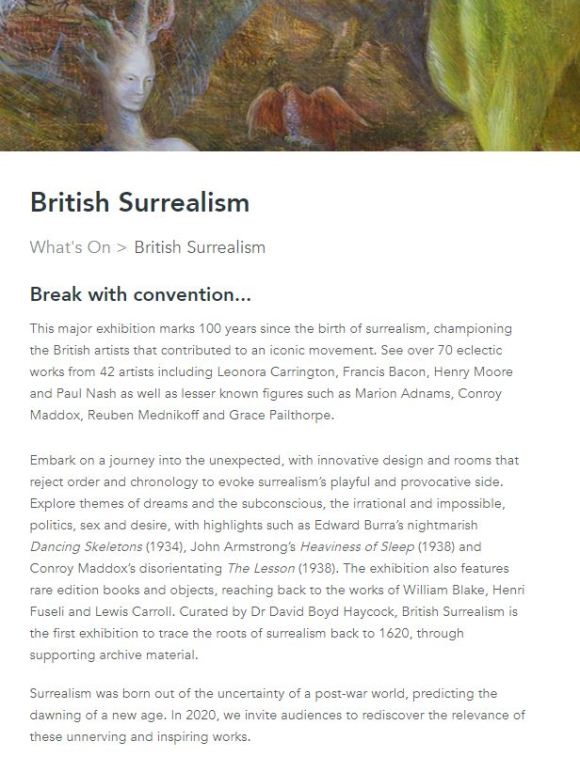
As stated, the exhibition ‘features over 70 eclectic works from 42 artists including Leonora Carrington, Francis Bacon, Henry Moore, and Paul Nash.’ This is alongside pieces from lesser-known figures such as Marion Adnams, Conroy Maddox, Reuben Mednikoff and Grace Pailthorpe.
On the website, the exhibition invites and entices the visitor to ’embark on a journey into the unexpected, with innovative design and rooms that reject order and chronology to evoke surrealism’s playful and provocative side.’ Themes that will be explored are ‘dreams and the subconscious, the irrational and impossible, politics, sex and desire’.
With my interest piqued, I set off for my visit on Friday 6th March. I have to admit (somewhat shamefully) that I hadn’t visited this gallery previously and was quite looking forward to the experience.
The following isn’t a critical examination of the exhibition, but a record of my observations and how these could contribute to enhancing my Body of Work for this module and future projects.
The gallery itself is a beautiful building that was opened in 1817 and the world’s first gallery designed to display art for the public. The permanent displays feature a range of masterpieces by revered artists such as Gainsborough, Murillo, Canaletto, and Rembrandt. When wandering around the various rooms, it’s like being in a box of organic dark chocolates. The paintings on show bathed in natural light combined with the heady smell of the oil paint give the space a real sensory experience.
Before entering the surrealism exhibition, there was one painting that caught my eye.


The fact that each flower was painted at a different time, creating a non-existent bouquet, triggered a potential line of inquiry. Something to be considered?
However, as the purpose and focus of my visit was the British Surrealism exhibition, I made a pact with myself to return to the gallery another day in order to appreciate this space as it should be.
Before entering the exhibition itself, the visitor is teased by one of the more well-known surrealist paintings, The Pomps of the Subsoil by Lenora Carrington.
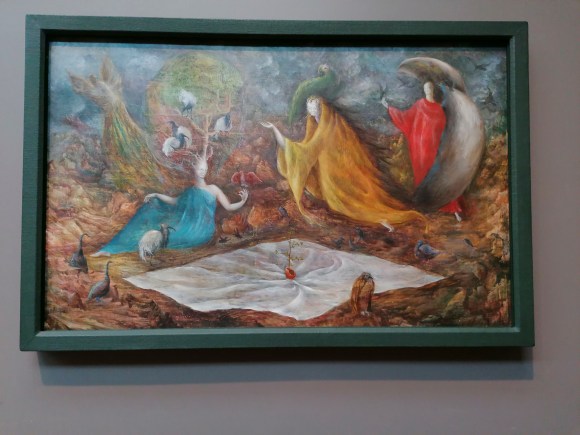
This painting depicts three figures surrounded by various bird-like creatures. There is a very dream-like feel to the painting – it does not appear ‘solid’ in comparison to the masterpieces in oil surrounding it. I suppose this could be thought of as a juxtaposition in itself, one of the main tenets of surrealism. When looking closer, the ‘birds’ have an ethereal, ghostly and translucent appearance.


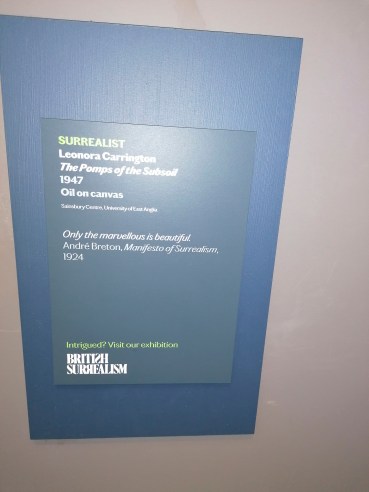
The accompanying plate gave just enough of a teasing taste of what was to come.
The entrance to the exhibition itself was indeed surreal.
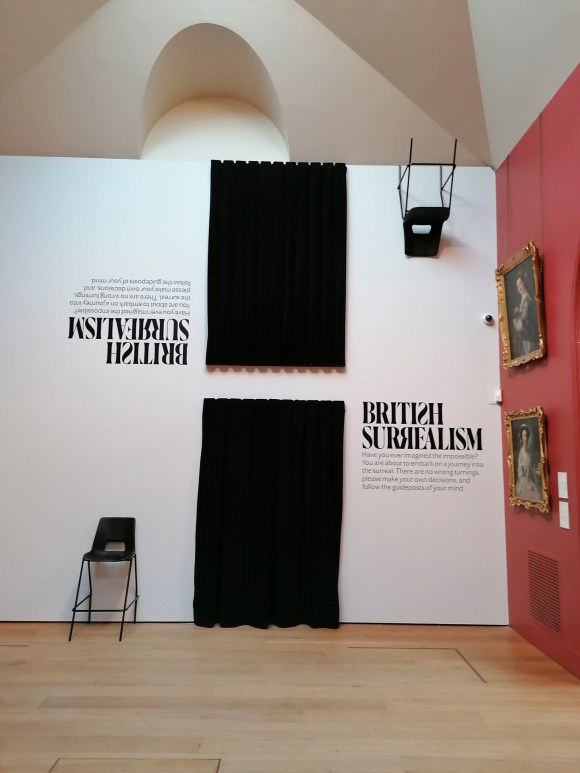
Ironically, I had already tried to access the exhibition via the exit. Maybe I should have started there?
I then entered into the first room via the black velvet curtain. To verify, it was the one closest to the floor. I think a staircase leading up to the one above may have been taking one surrealist twist too far.
As with the majority of exhibitions I’ve attended during my studies, there were the obligatory (and essential) wall explanations. These gave succinct introductions to aspects of surrealism explained in plain English. Very helpful for future reference.


The work on display was quite varied.


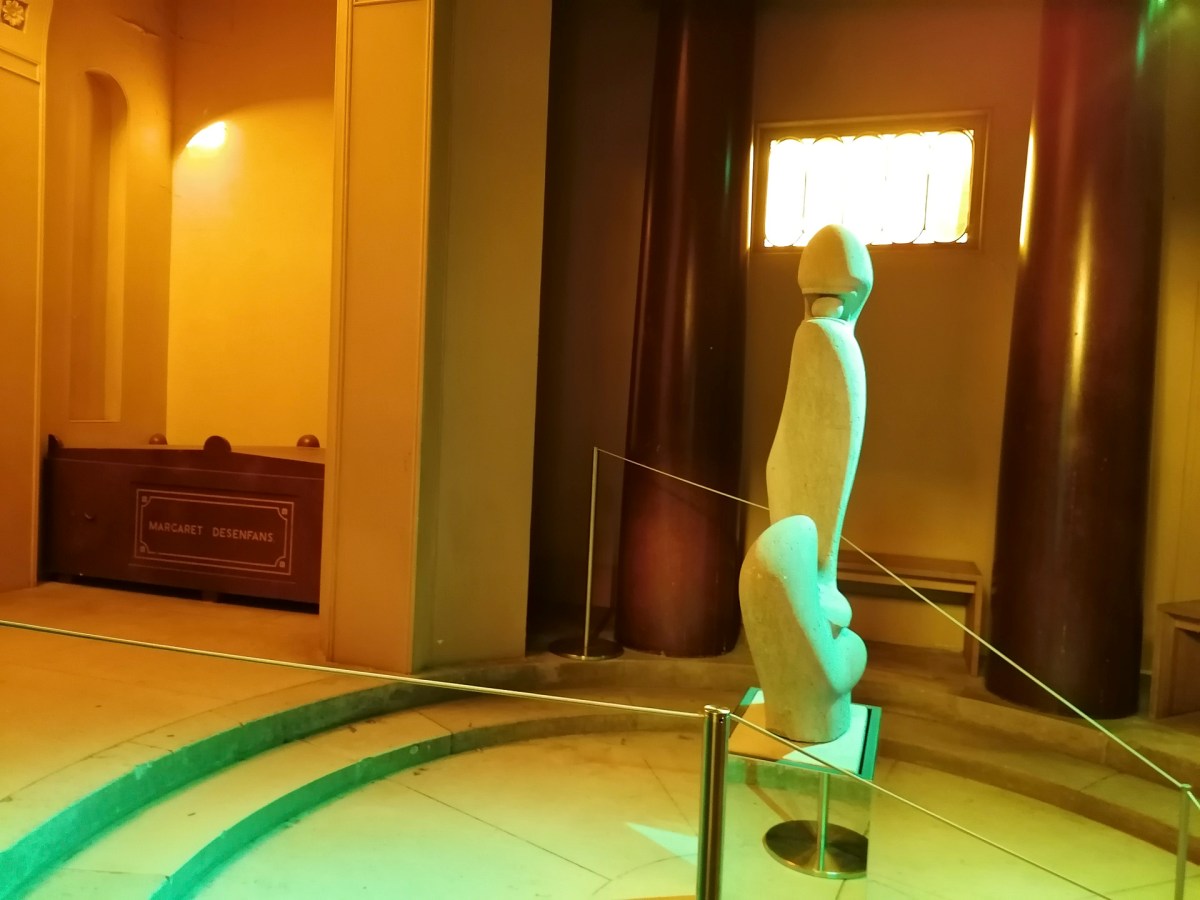
The piece of work that I took my time appreciating was F.E. McWilliam’s sculpture ‘Spanish Head (1938-39 Hopton Wood Stone).


This beguiling statue was placed in the Mausoleum within the gallery and bathed in an eery green light.
There were also prints and paintings that were considered to have influenced the surrealist art movement.
I had hoped that there would be more photography included in this exhibition. Whether it was due to a lack of British surrealist photography available or the fact that this gallery focuses on non-photographic art, I wasn’t sure at this stage. The only one on display was taken by Roland Penrose (husband of American photographer, Lee Miller).

This photograph features four of the key women connected to surrealism. Going from left to right, this depicts Lee Miller; the Guadelopian model Adrienne Fidelin; the English artist Leonara Carrington; and the French artist and performer Nusch Éluard.
With the above in mind, my next step was to extrapolate what makes this exhibition specifically useful, productive and relevant to my own research and practice.
References
Dulwichpicturegallery.org.uk. (2020). British Surrealism | Dulwich Picture Gallery. [online] Available at: https://www.dulwichpicturegallery.org.uk/whats-on/exhibitions/2020/february/british-surrealism/ [Accessed 7 Mar. 2020].
Farleys House and Gallery. (2020). Roland Penrose, Surrealist artist – Farleys House & Gallery. [online] Available at: https://www.farleyshouseandgallery.co.uk/people/roland-penrose/ [Accessed 7 Mar. 2020].
 Jennie Meadows MA Photography