Categories
AGM60 Research & Experimentation Posts

AGM60 Darkroom Workshops 11 & 18 February 2020

As part of the MA Photography course, the class had two darkroom workshops, one Black and White, the other Colour.

I was quite excited to try out the extensive darkroom facilities at the University of Brighton. The facilities at RHACC consisted of what appeared to be a broom cupboard painted with white walls. The only time I used during my four years at the college was to wash a cyanotype print. Also, the last time I had developed a photographic print was about 25 years ago. Apart from a brief foray into blueprinting, my photographic work since then has solely been digital.

In preparation for the workshops, I bought The Darkroom Handbook by Michael Langford. Published in 1981, it covers all the basics of processing, printing and manipulative techniques.
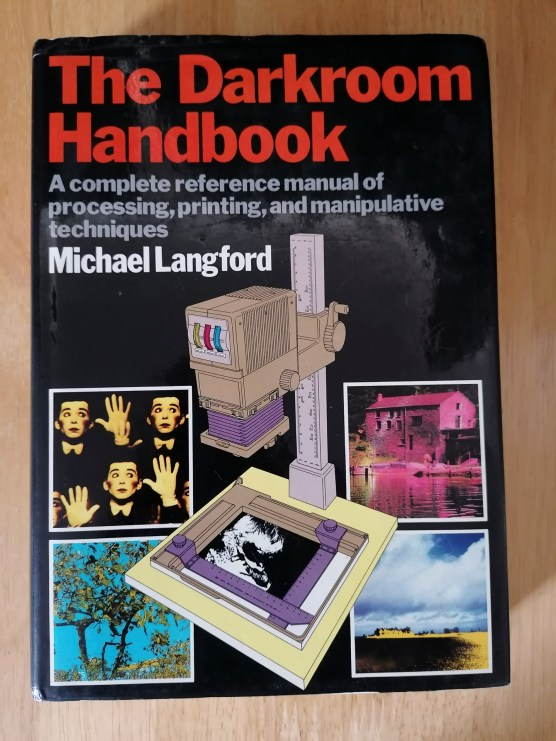
darkroom_handbook_michael_langford_low

At the time of my initial reading of this book, I already knew how to recreate a lot of the effects within this book digitally. It was great having a reference to how these could be achieved using the original analogue techniques and technology.

Black & White Darkroom Workshop

The first workshop on Tuesday 11th February focused on Black & White printing. This was so the class could get to grips with the basics. Mark, the Photography department’s Head Technician, took us through the process of Black & White printing. This introduction involved an orientation of the whole darkroom area and the printing process from start to end, plus all of the Health & Safety aspects. After this initial introduction, the class took a negative (either their own or borrowed) to process themselves. This is when I realised my lack of analogue photographic knowledge which made me more determined to get to grips with darkroom printing. It also was a great opportunity to recognise the differences between digital printing as well as the pros and cons of both.

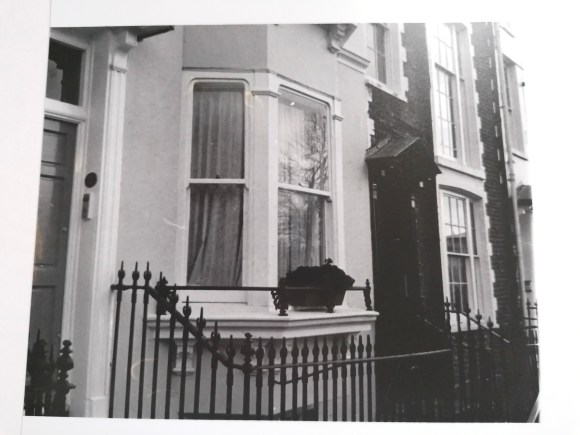
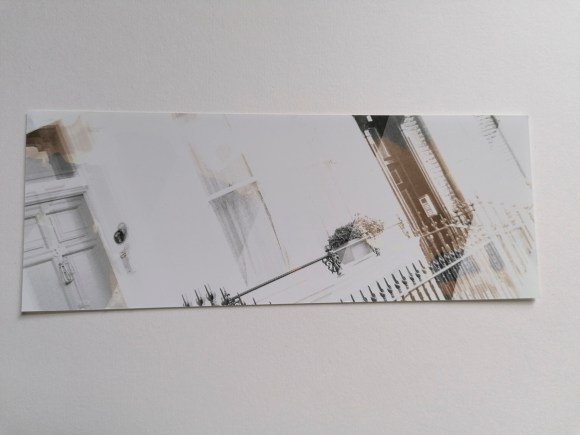
I won’t outline the whole process here, but this my initial test strip result. Not the most fantastic of prints, but it taught me a lot.
bw_test_strips_006_low

The first thing learned was the importance of using the test stip to calculate the correct exposure time. Also, how essential it is to leave the paper to ‘fix’ long enough so the print does not result in an unintentional sepia tone (as seen above).

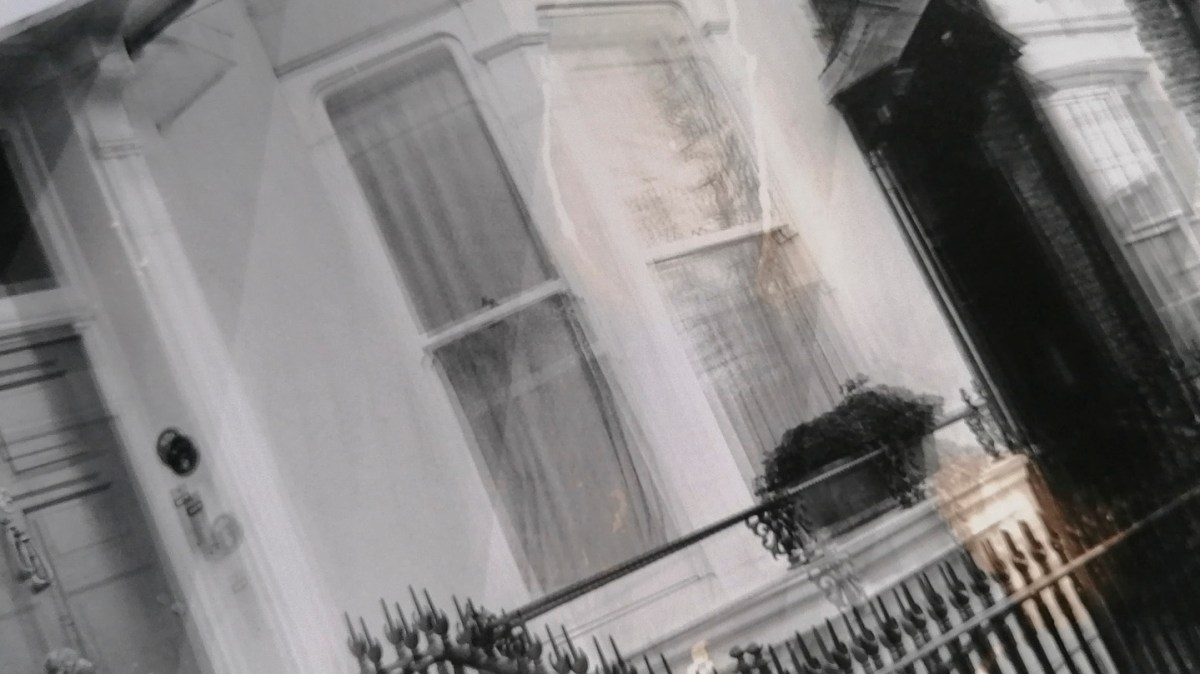
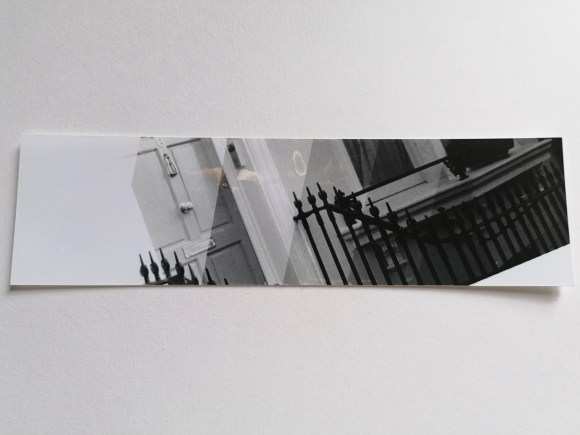
When it came to printing a larger version, I also learned that it’s essential to ensure that either the negative or the paper are not moved in any way. Otherwise, it results in a double image (as shown below).

I have to admit that it did take me the whole three-hour session to get to this stage. It does take me a while to get to grips with a new way of working and process the information. I learn best kinesthetically, which means I have to physically repeat a process several times in order to both understand it and carry it out myself. As such, I returned to the darkroom on Monday 17th February for another printing session.

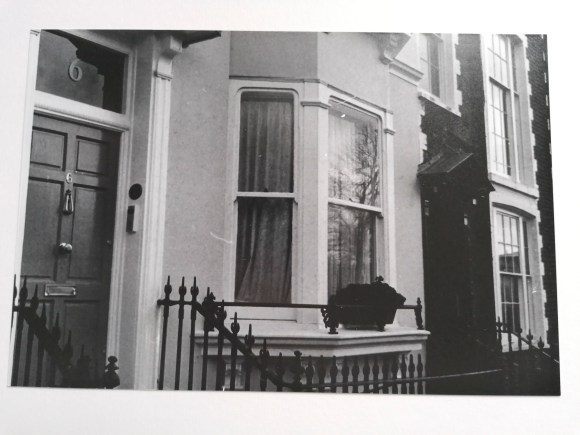
This was the resulting test strip.
bw_test_strips_008_crop_low

These were the resulting prints.

bw_print_1_low

bw_print_2_low

Not the best, but it was a good reminder of ‘practice makes perfect’.

Colour Darkroom Workshop

On Tuesday 18th February, the class attended the Colour Darkroom Workshop. This both had similarities and differences to the Black & White one the previous week. The similar aspects were the use of the negative and setting up the enlarger. The main differences were not being able to use any light when taking the photographic paper out of the black bag before exposure plus the use of a machine for printing rather than the developing, fixing and washing trays.

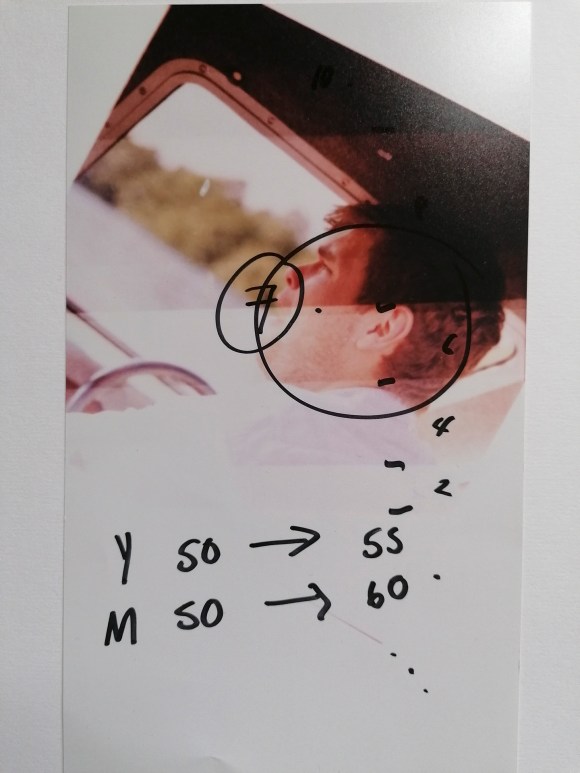
For this introduction to this type of colour printing, I borrowed one of my classmate’s negatives.
colour_test_strip_1_low

Again, I’m not going to note the whole process, but this I what I learned.

Firstly, it’s very easy to put the photographic paper with the emulsion side facing down on the masking frame. Which explains why the following two prints were the other way round.

Secondly, the colour tone of the print image can be changed by either increasing or decreasing the three primary print colours: Yellow, Magenta and Cyan.
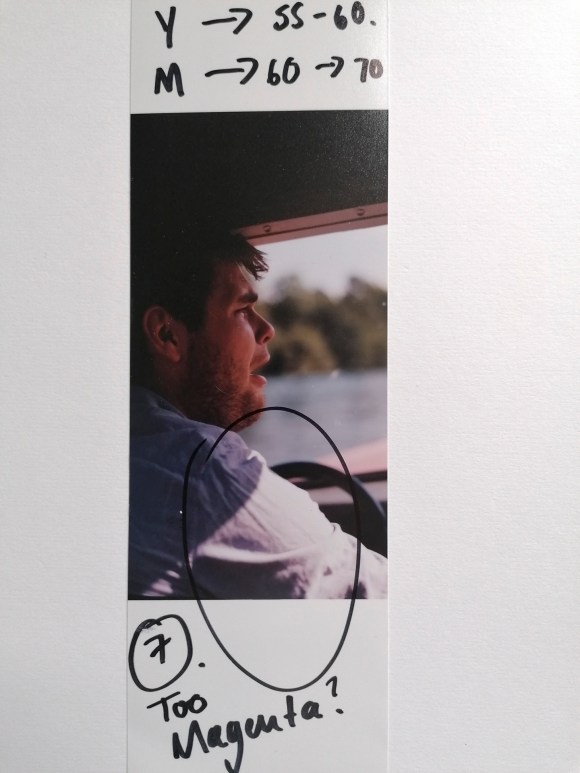
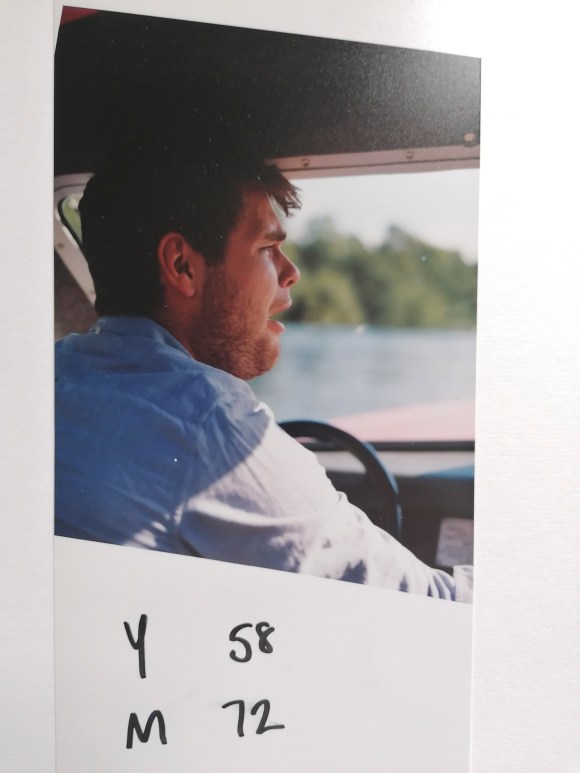
It takes a combination of numbers, colours and looking under a neutral light to get the right tone.
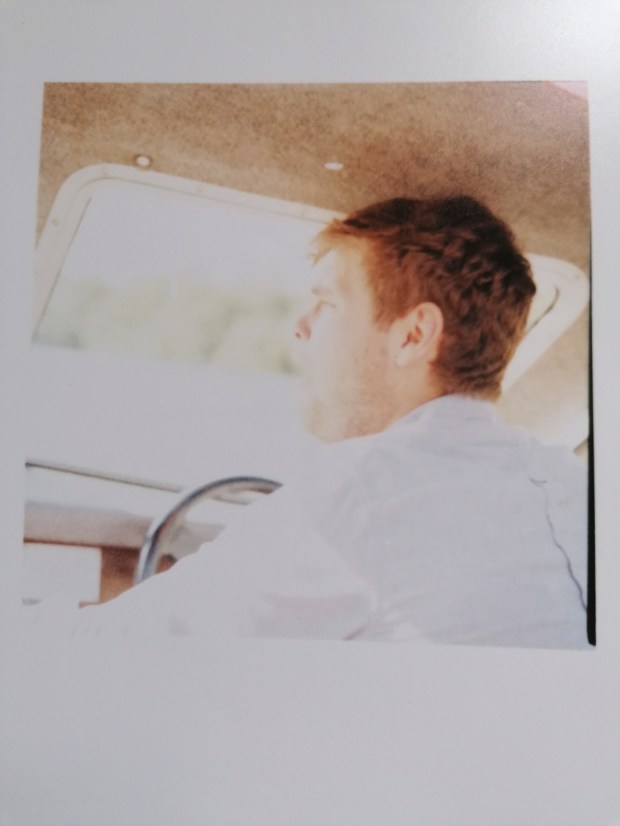
colour_test_print_3_low

Again, it would have helped if I had the paper the right way round for this final print.

The main thing I did learn is that by using the colour enlargers, a richer contrast can be created using Black & White prints. A bit like split toning in Adobe Camera Raw or Photoshop.

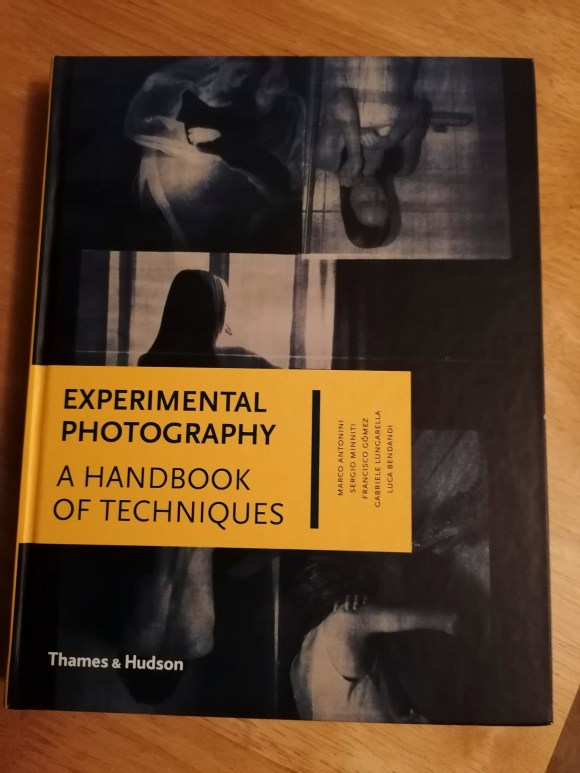
At this stage, I wasn’t sure if I would involve analogue processing in my work. However, there was a nagging feeling that I could use this at a later stage. I do have a strong interest in cameraless techniques and effects. I also know how to create my own negatives digitally. My first introduction to the darkroom involved making photograms when I was at primary school and that experience has always stuck with me. A book that I started reading at the same time as the one above is Experimental Photography: A Handbook of Techniques by Marco Antonini, Sergio Miniti, Fransicso Gómez, Gabriele Lungarella and Luca Bendandi.
experimental_photography_low

This inspiring book features a wide range of alternative techniques including cameraless, making one’s own cameras, operative hacks plus print and post-print experimentation. Again, lots more to be considered at this stage.

What I did take away from these two sessions is that it highlighted where my gaps in photographic knowledge laid. Also, I shouldn’t be too hard on myself that I didn’t understand the analogue processes as much as digital. Looking at how I used to take and process my digital images when I started compared to what I do now, it reminded me of the time, effort, mistakes and sheer hard work it took to me to get to my current stage. I also realised that this knowledge and experience could, and should, be applied to my work going forward.
Categories
AGM61 Contemporary Debates

AGM61 Contemporary Debates Essay Result and Feedback

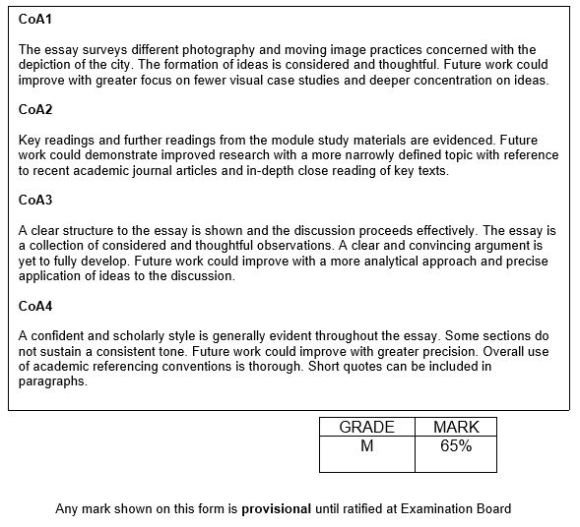
I am pleased to have gained a mark of 65% for my first piece of work.

https://jenniemeadowsma.photo.blog/2020/02/27/agm63-contemporary-debates-essay/


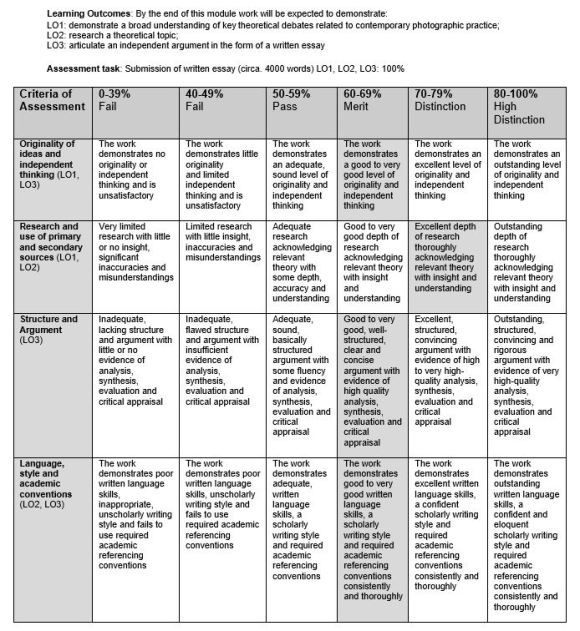
Below is how the mark was broken down with regards to the fulfillment of the Learning Outcomes in relation to the Criteria of Assessment.


Assessment Criteria JM

In addition to this, further comments and advice on how future work might improve are included:

Assessment Feedack JM


Very concise and useful feedback.

This was the result of a challenging first Semester during which I was re-introduced to cultural and photographic theory while being brought up to date with the developments of the last 20 years. In addition, there was an adaptation of studying in a new place at a different pace and level of learning. There was also the demands of working with different tutors and classmates, plus the rigours of commuting.

Overall, I was very pleased with the result and am looking forward to getting to grips with the next two modules, AGM60 Research & Development and AGM63 Dissertation.


Categories
AGM60 Research & Experimentation Posts

AGM60 SWOT Analysis 9 February 2020

A further useful tool I was introduced to during my HNC is SWOT analysis. This tool helps in defining and understanding one’s specialist areas and the opportunities available. This analysis also assists in identifying and mapping one’s own qualities and skills.

A SWOT analysis is commonly used in the professional world to evaluate the past, present and future position of a company. A personal SWOT analysis can do the same for an individual in pursuit of their career goals. By using this tool, I could get a new perspective on what I can do well, where my challenges lie and which avenues I should pursue.

The four categories within a SWOT analysis are:

    1. Strengths
    2. Weaknesses
    3. Opportunities
    4. Threats


This was my SWOT analysis for this module as of 5th March 2020, developed from the original one I formulated on 9th February. Due to the current global situation, this is not a complete list and will be amended when necessary for my reference.


SWOT – AGM60 Research & Experimentation

Strengths

  • Creativity
  • Determination to succeed
  • Photography qualifications
  • Previous photographic studies and experience
  • Knowledge of printing and exhibiting
  • Access to resources and equipment (see below)
    • Own equipment
      • Camera – Nikon D750 DSLR
      • Various lenses
      • Tripod x 2
      • LED lights x 3 (portable)
    • UOB
      • Three studios
      • Black & White and Colour darkrooms
      • Equipment hire
        • On-Site print bureau


Weaknesses

  • Time management
  • Limited available money (income and funding)
  • Limited energy
  • Short-term memory issues
  • Lack of own equipment


Opportunities

  • Development of abstract concepts


Threats

  • Bureaucracy
  • Illness
  • Stuck in one venue (Brighton/Teddington)
  • Strike action
  • Temporary closure of UOB


Categories
AGM60 Research & Experimentation Posts

AGM60 Current Key Elements 8 February 2020

One of the aims of this unit is for me to identify the key elements of my own creative practice. While trying to work out the direction in which I would take in producing the Body of Work required, I realised I had to identify these elements that have influenced me so far.

Having spent the last four years developing my work and creativity, I knew I had to note and recognise what made me the photographer and artist I am at this stage. I also recognised that this module was the opportunity to develop the particular techniques I’ve honed so far in order to create a new body of work. As I’ve discovered, it gives a new project a much stronger foundation rather than starting from scratch.

A useful tool that I had encountered during my HNC was the SCAMPER technique, an idea generation process that utilises action verbs as stimuli. It is a well-known type of checklist developed by Bob Eberie that assists the person in coming up with ideas either for modifications that can be made on an existing product or for making a new product. SCAMPER is an acronym with each letter standing in for an action verb which in turn stands for a prompt for creative ideas. For a full explanation, go to

Unit 117: Pt 4 SCAMPER

With this in mind, my first step of this process was to breakdown my current Artist Statement to bring out the elements I could develop:

Photographer & Artist Definition

  • Challenges the limits of photography
  • Does not view photography as a unitary medium
  • Photography is a medium that can be utilised to produce innovative artistic works
  • Work uniquely considers visual aesthetics
  • Produces realisation of the subconscious by revealing the unseen


Photographic Specialisms

  • Abstract & portraits
    • Abstract images are based on photographs taken of wood, stone, water & other surfaces
    • These images are then printed on non-traditional substrates (specifically metal, glass, and silk)
    • Portrait photography is also abstract & printed on these substrates
  • Short films using time-lapse & hyper-lapse photographic techniques


Other Specific Interests

  • Fascination with light, patterns and colour
  • Has investigated how the substrate used reacts with the ambient light to change the colours
  • Initial forms of printing photographs such as Daguerreotypes, Tintypes, and Ambrotypes


Artistic and Stylistic Influences

  • Post-Impressionism
  • Surrealism
  • Art Nouveau


Artists’ Influences

  • Processes, concepts & techniques are echoed in my work:
    • Vincent Van Gogh
    • Claude Monet
    • Salvador Dali
    • JMW Turner


Photographic Influences

  • Duane Michals
  • Bill Brandt
  • Ernst Haas


Other Specific Influences

  • Installations:
    • Lisa West
    • Brian Clarke
    • David Spriggs
    • Olafur Eliasson
  • Moving Image:
    • Oskar Fishchinger
    • Jordan Belson
    • Norman McLaren
    • Steina & Woody Vasulka.


Categories
AGM60 Research & Experimentation Posts

AGM60 Initial Thoughts 4 February 2020

During the first Seminar, the following task was sprung upon the class – an Informal Presentation. My fellow students and I were asked to give a 5-to-10 minute informal presentation of our initial research idea and direction for our projects verbally.

This was to include a brief summary of our project idea, a very basic contextualisation of this idea – specifically in relation to important and fundamental references for our project (photographic and otherwise), and a suggestion of how we plan to proceed through the creative process and final production of the work.

Following each presentation, there was to be a brief discussion to contribute constructive feedback and suggestions to one another.

I have to admit that this was a bit of a curveball for me. As someone who does like to plan and hates change, it was a bit like an electric shock to the system. I realised I had spent so much time in the first Semester consumed and distracted by photographic theory and the practicality of essay writing, I had given little brain space to anything creative. Also, having been used to the tight brief of my studies over the previous four years, this ‘freedom’ of no limits was quite daunting.

Despite my initial brain freeze, I did have a few things in mind, which I explained to the class:

Concept 1:

A time-lapse piece inspired by music by the composer Colin Riley. I had worked on a project involving this talented individual in November 2019 and one of the featured pieces literally struck a chord with me. This would be a combination of my particular time-lapse technique with my own style of portraits. The subject would be involving a dancer moving to the music and expressing both this and the accompanying words.

Concept 2:

The use of camera-less techniques, specifically Cliché Verre. This method involves either etching, painting or drawing on a transparent surface, such as glass, thin paper or film and printing the resulting image on a light-sensitive paper in a photographic darkroom. It is a process first practiced by a number of French painters during the early 19th century. I saw an example of this at the Dora Maar exhibition at Tate Modern, which I will explain further in another blog entry. I also mentioned the use of photograms, which was also sparked by this exhibition.

With a set date of the 17th March as the deadline to present the first stages of work, the next step was to brainstorm and mind map these and other potential concepts and start producing some work. There was also a selection of photographic workshops to attend. Time for the creative process to begin.


Categories
AGM60 Research & Experimentation Posts

AGM60 Research & Experimentation Module Introduction 4 February 2020

The first seminar of this module introduced the class to the requirements of this practical module. In addition, it gave the group the opportunity to discuss these requirements in relation to the practice work. After the first Semester’s focus on pure theory and analysis, it was both exciting and daunting to take the first steps to the production of work at this level.

One of the main aspects of this module is how I will be encouraged to engage with the notion of ‘research’ in relation to my own possible subject matter and photographic themes of interest. This has been an on-going theme with my studies so far, specifically with my Level 2, 3 and four courses. This research contributed to and strengthened my -photographic practice, giving it a more solid and informed foundation.

The seminar started with a presentation by the Module Leader, Xaviar Ribas, and Module Tutor, Fergus Heron.

In addition to the introduction, it was outlined to the class as to what ‘research’ means generally in relation to contemporary art and/or photographic practice. Also highlighted were the various approaches and strategies I may use in terms of:

  • Building, developing and formalising a practice-based ‘research dossier’
  • Considering how I can make the documentation of research an effective, streamlined and productive aspect of my studies

The class was also introduced to what is expected in terms of the research dossiers that will be submitted alongside practice-based work throughout the MA

The following is a summary of the presentation given by Xaviar and Fergus during the seminar:

What is Research?

  • What is meant by ‘research’?
  • Why is this research necessary?
  • How is research useful for me as a practitioner?

The Point of Research

  • Understanding the context of a text/image
  • Understanding what I/the author/the artist is trying to do
  • Understanding a historical position
  • Being aware of the current arguments and contemporary discussions around it
  • Using it as the beginning of a journey
  • Opening up further questions/investigations
  • Changing and extending the way in which we see it
  • Beginning to map an intellectual or creative landscape
  • Recognising contradictions, misperceptions, suppressions, etc.
  • Opening up new forms of engagement with my practice and the field


The ultimate aim of the above is to DEFINE, UNDERSTAND and DEVELOP:

  • A field of research
  • A field of practice


How to Record Research

  • Take notes
  • Write clear and considered summaries of texts, talks, exhibitions, events etc.
  • Write commentaries and responses to texts, talks, exhibitions, events etc.
  • Gather relevant information so I can properly reference these
  • Produce extended bibliographies of intended/potential readings
  • Collect stuff (images, ephemera, etc.)
  • Write a journal/blog


Why Do We Submit Research for Practice?

  • To demonstrate the scope and depth of a project
  • To demonstrate a confident working process
  • To show all developmental work
  • To prepare for explaining, contextualising and justifying one’s work for others


What is a Research Dossier?

Although there is no correct format, my research dossier should be:

  • Edited/streamlined
  • Written with reflective consideration
  • Truthful/honest/self-reflective
  • Critically considered and unembellished


Suggested Content for a Research Dossier

  • Project proposal: identifying key questions, contexts and fundamental reasons for my project
  • Primary visual & artistic influences and references including in-depth, critical and reflective consideration of each, both in general and specifically in relation to my project
  • Primary historical, critical and theoretical influences and references including in-depth, critical and reflective consideration of each, both in general and specifically in relation to my project
  • Production research, development, and experimentation: identifying and reflecting upon research, development, and experimentations in terms of the actual/practical production of the project itself
  • Bibliography: including proposed future readings/references relevant to the project and a list of artworks and sources [Guide to the Harvard referencing system: http://www.citethisforme.com/harvardreferencing]
  • Artist Statement: to accompany and support my portfolio of practice
Categories
AGM60 Research & Experimentation Module Details

AGM60 Module Timetable and Submission Points

The following is the tutorial timetable and submission points for the AGM60 Research & Experimentation module so I can refer to this post during this unit.

The information is correct as of 11 May 2020.


Tuesday 4 February 2020 @10.00-13.00 (Edward Street, Room 207)

Module Introduction – Research in Practice

Lecturers: Xavier Ribas and Fergus Heron

This session will discuss the requirements for practice work for this module.

Full details:

AGM60 Research & Experimentation Module Introduction 4 February 2020


Tuesday 11 February 2020 @10.00-13.00 (Edward Street, B11)

Workshop: Black and White Darkroom

AGM60 Darkroom Workshops 11 & 18 February 2020


Tuesday 18 February 2020 @10.00-13.00pm (Edward Street, Room 104)

Seminar: Writing and Managing Proposals, Statements, Contexts, References, Resources, Planning, Time Management

Lecturers: Fergus Heron and Xavier Ribas

For this session, the class will discuss various strategies for writing and managing formal written proposals, and how to present clear, in-depth and focused proposals that support, promote, and clarify my photographic work for both myself and others.

Full details:

AGM60 Seminar Strategies for Writing 18 February 2020


Tuesday 18 February 2020 @14.00pm to 17.00pm (Edward Street, B12)

Workshop: Colour Darkroom.

AGM60 Darkroom Workshops 11 & 18 February 2020


Tuesday 25 February 2020 @10.00-13.00 (Edward Street, G08) 

Workshop: Studio Lighting.

AGM60 Studio Lighting Workshop 25 February 2020


Tuesday 25 February 2020 @14.00-17.00 (Edward Street, B05)

Workshop: Preparation for Digital Printing.

AGM60 Preparation for Digital Printing Workshop 25 February 2020


Tuesday 3 March 2020 @10.00-13.00 (Edward Street, B05)

Workshop: Adobe Photoshop Skills.


Tuesday 3 March 2020 @14.00-17.00 (Edward Street, B05)

Workshop: Adobe Classic Lightroom Skills.

Both workshops:

AGM60 Adobe Photoshop and Lightroom Classic Workshops 3 March 2020


Tuesday 10 March 2020 @10.00-13.00 (Edward Street, Room 211) 

Group Tutorials – canceled due to strike action.


Tuesday 17 March 2020 @10.00-1300 (Edward Street, Room 207)

Seminar: Library and Field Research – Exhibitions, Talks and Events, Conversations with Other Artists/Photographers, Researching ‘Outside of the Box’

This session did not go ahead due to the current situation.

Instead, an online tutorial with Xavier Ribas (Course Leader) took place. This tutorial covers elements of the task required for the seminar.

AGM60 Seminar Discussion of Project Work 17 March 2020


Tuesday 24 March 2020 @10.00-13.00 (Edward Street, B05)

Workshop: InDesign Workshop

This was rearranged for Monday 11 May 2020


Tuesday 24 March 2020 @14.00-15.00 Off Campus*

Visit to Spectrum (Brighton-based photographic printer)


Tuesday 24 March 2020 @16.00-18.00 (Edward Street, Room 211)*

Visiting Lecturer: TBC

*Two activities for 24 March 2020 did not go ahead due to the current situation.


Tuesday 31 March 2020 @10.00-13.00 (Edward Street, Rooms 104 & 211)*

Group Tutorials

*Took place via Microsoft Teams due to current situation:

AGM60 Feedback 31 March 2020


Tuesday 7 April 2020 SPRING BREAK

Tuesday 14 April 2020 SPRING BREAK

 Tuesday 21 April 2020 SPRING BREAK


Tuesday 28 April 2020 @10.00-13.00pm (Edward Street, Room 211) 

Seminar: Projects in Context

Lecturers: Xavier Ribas and Fergus Heron

This week the class will discuss the contextualisation of our projects, both specifically in relation to relevant photographic issues and debates (both contemporary and historical) and in relation to fields outside of photography.

In order to fully prepare to partake in the seminar I have to complete the tasks outlined here:

AGM60 Preparation and Tasks for Seminar 28 April 2020

This seminar was carried out online via Microsoft Teams due to the current situation.

Follow up actions and further research was noted here:

AGM60 Feedback from Seminar 28 April 2020


Tuesday 5 May 2020 ALL DAY

Study Visit – details TBC due to the current situation.

This was changed to a Seminar session held via Microsoft Teams where various exhibitions were discussed, including Among The Trees at the Hayward Gallery, Southbank.


Tuesday 12 May 2020 @10.00-13.00 (Edward Street, Rooms G14 (FHe) & 207 (XR))*

Group tutorials.

*Details TBC due to current situation.


Tuesday 19 May 2020 @10.00am to 1.00pm (Edward Street, Room 211)

Seminar: Technical Research and Resources, Process and Output

Lecturers: Xavier Ribas and Fergus Heron

This week I will, along with the class, be considering:

  • The creative, technical and practical elements of art/photography practice
  • The physical process of making my work
  • The final output of your research project


In order to fully prepare to partake in the seminar I have to complete the tasks outlined here:

AGM60 Preparation and Tasks for Seminar 28 April 2020


Tuesday 26 May 2020 @14.00-17.00 (Edward Street, Room 103 (FHe) & 104 (XR))

Group tutorials

*Details TBC due to current situation


Tuesday 2 June 2020 @10.00-17.00 (Edward Street, Room B03)*

Final Review**

Assessment of practice work and research dossier

*Subject to the current situation

**Subject to ‘no detriment’ policy


Tuesday 9 June 2020 @13.00 via Turnitin

Submission: Research Dossier

Categories
AGM63 Dissertation

AGM63 Dissertation Tutorial Timetable and Submission Points

The following is the tutorial timetable and submission points so I can refer to this post during this module.

The information is correct as of 20 April 2020.

Tuesday 4 February 2020 @14.00-15.00 (Edward Street, Room 211)

Module Introduction

Tuesday 5 May 2020 @13.00 via Turnitin

Submission: Dissertation proposal and literature review

Tuesday 12 May 2020 @14.00-14.20 (Edward Street, Room 216*)

Tutorial: Feedback on research development and proposal

Tutor: Stephen Bull

Tuesday 16 June 2020 @14.00-14.20 (Edward Street, Room 216*)

Tutorial: Research development review

Tutor: Stephen Bull

Tuesday 23 June 2020 @14.00-14.20 (Edward Street, Room 216*)

Tutorial: Feedback on research development and proposal

Tutor: Stephen Bull

Tuesday 7 July 2020 @13.00 via Turnitin

Submission: Draft dissertation

Tuesday 14th July 2020 @14.00-14.20 (Edward Street, Room 216*)

Tutorial: Feedback on draft dissertation

Tutor: Stephen Bull

Tuesday 1 September 2020 @13.00 via Turnitin

Submission: Final dissertation

*Meeting via Microsoft Team, if necessary

Categories
AGM60 Research & Experimentation Module Details

AGM60 Research & Experimentation Module Specification

Description:

This module will introduce me to various research tools and strategies and encourage creative experimentation.

I will research and use the production process to reflect upon:

  • The key elements of my own creative practice
  • The photographic language I wish to explore
  • The position of my practice within relevant photographic fields


I will develop an individual Body of Photographic Work.

To support this Body of Work, I will produce an accompanying Research Dossier.

I will consult my peers and critique collaboratively and, in turn, support their research and practice.


Aims:

This module aims to:

  • Identify, develop, experiment with, and expand upon the key elements of my own creative practice.
  • Support those key elements and my creative practice through:
    • creative experimentation
    • critical inquiry
    • research
    • peer discussion
    • reflective evaluation


  • Provide a framework in which I will develop independent practice and research strategies that underpin my future practice and subsequent project development.


  • Introduce me to practice-based research methods, enabling me to:
    • research the broader context of my creative practice
    • engage with contemporary debates about photography
    • understand the relationship between theory, practice, process, and documentation


Learning Outcomes:

On successful completion of the module, I will be able to:

  • Plan, develop, research, and document an extended body of experimental work. (LO1)
  • Acquire and apply appropriate technical skills as defined by my photographic practice. (LO2)
  • Demonstrate a clear understanding of the ideas, issues, and different visual contexts underpinning my own photographic practice. (LO3)
  • Demonstrate a critical awareness of historical and contemporary debates around research-based photographic practice. (LO4)


Content:

This module introduces me to the principles of research-based photographic practice.

The purpose of this module is to provide myself a new point of departure for my practice that will enable me to:

  • Open out new possibilities for experimentation
  • Identify key issues/strategies/ideas that are central to my development as a practitioner.


The module consists of a number of seminars exploring contemporary issues within photographic culture around:

  • Research
  • Documentation
  • Contextualisation
  • Conceptual approaches
  • Theoretical approaches
  • Creative experimentation


I will be required to develop and individual Body of Work and accompanying research dossier for assessment.

The module concludes with a formal Final Review, attended by students and staff from across the course.

I will, along with my fellow students, introduce my work with a short oral presentation. This will be followed by a group critique with lecturers and peers.


Teaching and Learning Activities:

An introductory briefing will be followed by a series of:

  • Lectures
  • Group seminars
  • Practical workshops
  • Individual tutorials
  • Group tutorials
  • Visiting lecturers
  • A Mid-Point Review (formative assessment point)
  • A Final Review (summative assessment point)


The module adopts a blended learning approach supported by online study materials, available through StudentCentral. These include (when appropriate):

  • Readings
  • Journal Articles
  • Interviews
  • Videos
  • Social media resources


Allocation of Study Hours:

Scheduled: 60

Guided Independent Study: 340

Total Study Hours: 400


Details of Assessment (Coursework):

Assessment Task 1:

I will produce a Body of Photographic Work submitted in an appropriate form. For example, a portfolio of prints, an installation, a projection or otherwise.

I will accompany this with an Artist Statement of 200 words.

LO1 & LO2 (50%)

Assessment Task 2:

I will produce a formal and critically reflective Research Dossier of 3-4,000 words that supports the above Body of Work. I will include:

  • Documentation and reflective critical evaluation of the creative process undertaken during the module.
  • A critical analysis of a set of visual references that demonstrate an appropriate context for the Body of Photographic Work.
  • A critical analysis of a set of historical and theoretical references that support the development of the Body of Photographic Work.
  • A bibliography and list of research resources.


LO3 & LO4 (50%)

Categories
AGM60 Research & Experimentation Module Details

AGM60 Research & Experimentation Module Brief

The second unit for the MA Photography focused on Research and Experimentation. The purpose of the module was to produce a body of photographic work and a supporting research dossier. This was in order to give me and my fellow students the opportunity to develop our practical photographic work in the context of historical and contemporary photographic practice. The following is the module brief:

Level: 7

Credits: 40

Assessment Task 1: Submission of a body of photographic work (50%)

Assessment Task 2: Research Dossier (50%)

Learning Outcomes

I will be assessed against the following Learning Outcomes:

LO1: I will plan, develop, research and document an extended body of experimental work.

LO2: I will acquire and apply appropriate technical skills as defined by my photographic practice.

LO3: I will demonstrate a clear understanding of the ideas, issues and different visual contexts underpinning my own photographic practice.

LO4: I will demonstrate a critical awareness of historical and contemporary debates around the research-based photographic practice.

Task Details:

Assessment Task 1:

I will produce a Body of Photographic Work submitted in an appropriate form. For example, a portfolio of prints, an installation, a projection or otherwise.

I will accompany this with an Artist Statement of 200 words.

LO1 & LO2 (50%)

Assessment Task 2:

I will produce a formal and critically reflective Research Dossier of 3-4,000 words that supports the above Body of Work. I will include:

  • Documentation and reflective critical evaluation of the creative process undertaken during the module.
  • A critical analysis of a set of visual references that demonstrate an appropriate context for the Body of Photographic Work.
  • A critical analysis of a set of historical and theoretical references that support the development of the Body of Photographic Work.
  • A bibliography and list of research resources.

LO3 & LO4 (50%)

Design a site like this with WordPress.com
Get started