During the session on 3 March 2021 our tutor, Rachel, went through a presentation outlining the two tasks for the module. The following is an adaptation of that presentation for my reference.
Note to self – examples of other photographer’s websites and elements to be considered for this module are featured within the original presentation.
Task 1
A Professional Portfolio presented on a website to include as appropriate elements from among the following:
- Artist’s statement
- Biography
- C.V.
- Bodies of photographic work appropriately captioned or annotated
- Textual information on any relevant technical details and material qualities of work
- Any relevant web links to social media use, exhibitions or publications as appropriate
80% (LO2, LO4)
Task 2
A report on the online portfolio articulating the professional strategy, principles underlying the organisation of the material, the design and intended audience (1500 words).
20% (LO1, LO3)
The following diagram highlights how the two tasks work in relation to each other.
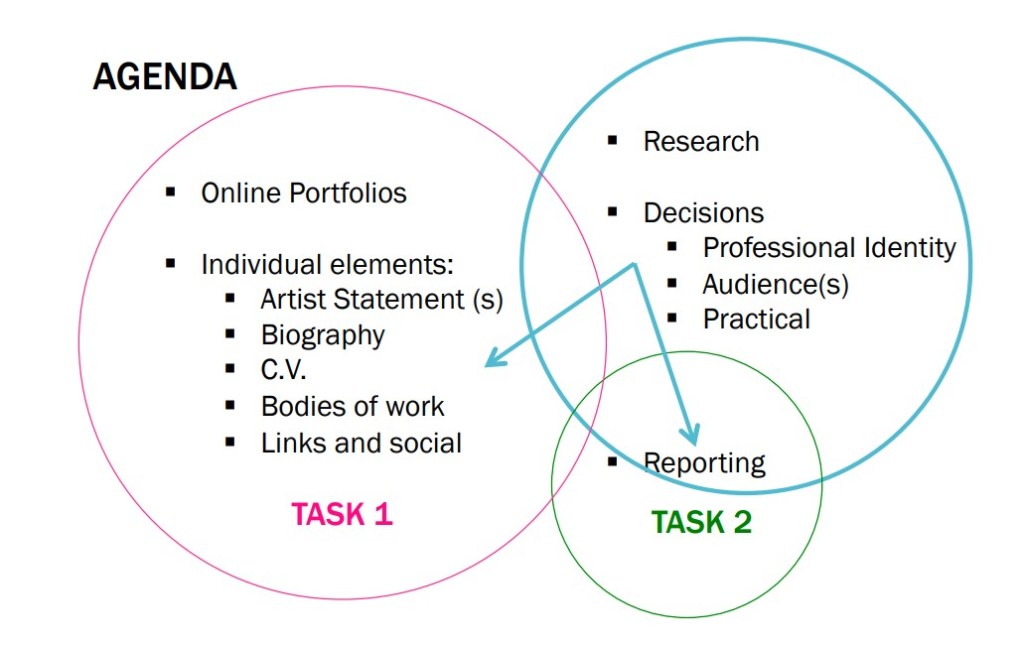
Online Portfolios
There is no doubt that it an industry standard to be able to be ‘found’ online, but this can take different forms (including multiple platforms, such as static/social/represented.). There are many different ways to showcase my work online.
- In general, online portfolios are types of websites, and they can be realised in different ways according to:
- My (intended) professional profile
- My audience(s)
- Practical reasons (bandwidth, technical skills, finance etc.)
My current online presence is through my website: http://www.jenniemeadows.com. This was set up in 2016 and the details of its creation and realisation can be read here:
Unit 4: Pt 7 Web Presence & Portfolio Ts 3 & 4 LOs 3.1, 3.2 & 3.3, 4.1 & 4.2
I will revisit these details then analyse my site to see how it can be improved after the following sessions.
10 March 2021 2pm – 5pm: Eva Bensasson – Websites for Photographic Practices
- Research / Scoping the Field
- Planning your website
17 March 2021 2pm to 5pm: Seán Birnie – Building Websites using Online Platforms
- Introduction to easy-to-use options for building a site
- Practical overview on how they work
This will be covered in a separate post (add link when done).
First Thoughts
My website is my representation when I cannot be there. It is a projection of ‘me’.
Be professional and act professionally.
What is the purpose of my website? (this will inform decisions on every element.)
Is it to:
- Showcase your work?
- Sell your work?
- Offer other services (teaching, writing, assisting etc.)
At the time of writing, the purpose of my website is to showcase my work. I will not be actively selling my work through my website at this time. However, I will be considering my platform options to do this in the future. With my current website platform provider, Squarespace, there is an option to have direct sales. The other option is to sell through sales platforms, including Etsy and Saatchi Art.
Website Elements – Artist Statement
An artist statement is a description of myself as an artist/my practice.
The statement stands in for me when I can’t be there
An artist statement can also be a description of a specific body of work.
This statement stands in for me, talking about the work, when I can’t be there.
My online portfolio may contain a mix of both types.
Artist Statement Tips
The following is in relation to the mistakes I should avoid when applying to a photography grant, as advised by Photographic Museum of Humanity but can also apply to writing an Artist Statement.
When well written, an Artist Statement should show self-confidence and that I own my creative work. This will help viewers to engage with it and understand my perspective. I want the statement to be clear, accurate and synthetic.
Divide the text into clear paragraphs and start with a strong introduction. Always have a second pair of eyes to proofread your statement. You could also try a free app like Grammarly.
Artist Statements are:
- Clear
- Meaningful
- Descriptive
- Accurate
- Fairly concise (150-500words)
Style:
- Be honest
- Try to capture my own speaking voice
- Avoid repetition of phrases and words
- Look for sentences that say the same thing I said before, but in a different way – choose the better of the two.
- Vary sentence structure and length
- The length of a sentence should relate to the complexity of the idea.
- Organisation of detail is important – significant ideas should be at the end of each sentence for emphasis
Artist Statements can include:
- Aims
- Themes, concepts
- Media and Materials
- Processes
- Rationale (of above)
- Key Influences
Ask myself:
- What am I trying to say in the work?
- What influences my work?
- How do my methods of working (techniques, style, formal decisions) support the content of my work?”
- What are specific examples of this in my work?
- Does this statement conjure up any images?
Artist Statements DO NOT include:
- Biographical information
- C.V. information
- Contact information
- Jargon
An Artist Statement is NOT:
- A press release
- Poetry or prose
- Anecdotal
“Here are a few things an artist statement is NOT: a manifesto, an art history lecture, a story about discovering art, short fiction, self-psychoanalysis, a string of adjectives, a grand theory of everything you’ve ever made, or a list of your career accomplishments…”
(Francis Hodgson)
Artist Statement – Getting Started
Possible strategies:
- Start with a list of adjectives
- Record a conversation of you talking about your work to another person
- Write a letter (you never have to send it!) explaining our work to your family/friend/other
- It’s always easier to edit something that exists than start something new – so write something/anything and then revise it
- Speak it out loud
- Get others to read it
- Look at my work while I write!
Very good article about writing artist statements:
https://www.redeye.org.uk/opinion/writing-about-your-photography
Very good examples of different length artist statements and bios available here:
https://www.gyst-ink.com/sample-artist-statements
Website Elements – Biography
An artist biography is a summary of my C.V. in sentence format. It is used to locate me – physically and intellectually.
“I am an X-based artist, who makes work about XYZ.”
It can include:
- Education
- Exhibitions and publications
- Awards and achievements
- An overview of your practice/yourself as an artist (one sentence!)
- How you got from place to place.
“Since graduating with a BA(Hons) in Photography at the University of Brighton 2017, I have exhibited widely, including … XYZ.”
- Biographies are short: 50-150 words
- Biographies are factual
- They can be written in the first or third person
- “I am an artist…”“Jennie is an artist…”
- Writing tip: It can be useful to write it in the third person, then change it to the first person for publishing.
Biographies DON’T include:
- Jargon
- Opinion
Very concise and clear article about writing biographies is here:
https://www.artquest.org.uk/how-to-articles/biography/
Website Elements – C.V.
A C.V. is a list of my achievements so far, and includes:
- Contact information
- Education
- Relevant employment
An artist C.V. might include the following sections:
- Artist Statement
- Exhibitions (Solo and Group)
- Publications
- Commissions
- Awards
- Residencies
A C.V. should be:
- 1-2 sides A4 max/or one web-page
- Written in written reverse-chronologically
- Kept up-to-date
- Rearranged for different emphasis – e.g. when applying to different things (jobs, exhibitions, grants etc.)
- Be downloadable/emailable version for someone to print out (make sure fonts are legible)
C.V.s don’t include images.
Further info: https://www.artquest.org.uk/how-to-articles/artist-cv/
Website Elements – Side-By-Side
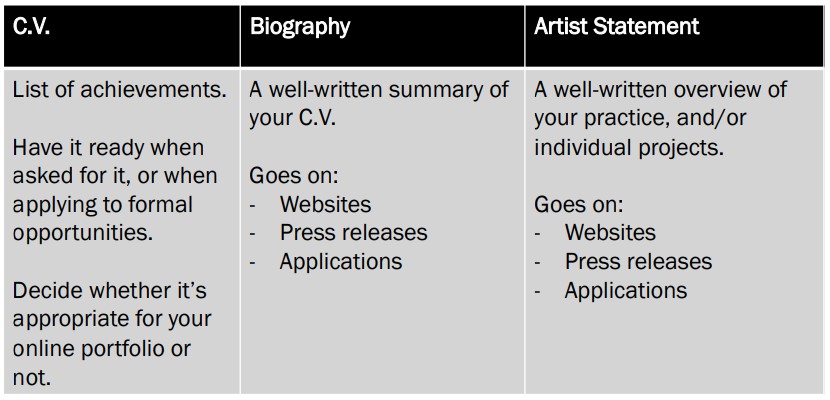
Website Elements – Organisation
Biography / C.V. / Artist Statement
These elements tend to get grouped under one place on a website
ABOUT
CONTACT
BIO/C.V.
Bodies of Work
I need to work out how they might operate together.
One of the key parts of my online portfolio is to showcase my visual work.
- It is common to group images for coherence.
- This could be by project
- It could be by theme (portraits, landscapes, commercial, fine art …etc.
- I also need to decide how many images is appropriate for MY website.
- e.g. Is a handful of representative images from a project, or most of them?
Bodies of Work’s Organisation
I must consider how other organise this part of their website:
- Is there a menu item for each project?
- Are projects/bodies of work curated under main headings?
A very practical thing to consider here might be how much work I have
- What do I want to include?
- What do I want to exclude?
- Which images best serve my purpose of showcasing my work and my ability as a photographer/artist?
Image Annotation
Images should be annotated – elements of description include:
- Name of the work
- Date of creation
If relevant:
- Name of the series it’s from
- Materials/Duration
- Size
- Framing
- Price
- Edition
Other important information:
- Name of author
- Copyright assertions
For the purpose of my website, the above could be situated on the website somewhere to cover all images, which may be more appropriate than adding them to each image. (But it’s up to me).
Links & Social Media
It can be important to consider how my website/online portfolio works in the larger context of my other online media and platforms.
What information flows to my website, and out from, my website?
Consider use of Instagram, Twitter, Facebook, LinkedIn, Blogs, Specific exhibitions/other gallery websites, Source Graduate Online, mailing lists.
What’s the key use of each, and how might they augment my online profile overall?
I currently have a link to my Instagram account, on which I post finalised images and work-in-progress. I also post location images and if there is of anything of interest I want to share with my followers. I also have a LinkedIn profile. I also post occasional blog posts on my website that I share to Instagram (via my profile) and my LinkedIn feed.
I have recently read the chapter within Navigating the Art World: Professional Practice for the Early Career Artist that focuses on how to capture an audience by effectively using social media. The notes from this chapter can be accessed here:
AGM59 Notes on Effective Social Media 16 February 2021
Effective Use of Links & Social Media
Many are focused on interactive engagement so be careful to not just push stuff out – no one likes to be bombarded by info.
Be aware of GDPR rules for things like mailing lists:
https://www.gov.uk/government/publications/guide-to-the-general-data-protection-regulation
It takes time to learn use a platform, get used to it, and then use it better…so get started NOW.
Many offer Analytics with certain types of accounts – can they help
you work out their effectiveness?
A really good, and in-depth article on various platforms, their uses and benefits is available here:
https://www.artquest.org.uk/how-to-articles/social-networks-and-blogs/
Professional Profile
What part of my professional self is this website representing?
- Artist
- Academic
- Commercial
- Mixture of above?
Who is the main audience? (who are additional audiences?)
- Galleries
- Funders
- Employers
Decisions To Be Made
- Which elements to include on my website.
- Individual decisions about each part as relevant (bio, statement, C.V.)
- How to organise your information, including:
- Menu items (and naming)
- Bodies of work
- Text
- Links
Report Writing
My report communicates what my online portfolio comprises of and explains the decisions, and decision-making processes that led to its creation.
I might include:
- Description of my professional identity
- My aims for the online portfolio
- Relevant research
- Decisions on individual elements
- Decisions made on layout and design
- Critical evaluation
Timeline Highlights
10 March 2021 2pm – 5pm: Eva Bensasson – Websites for Photographic Practices
- Research / Scoping the Field
- Planning your website
Actions Before Session:
Decide on my aim for portfolio/website
Bring Questions!
17 March 2021 2pm to 5pm: Seán Birnie – Building Websites using Online Platforms
- Introduction to easy-to-use options for building a site
- Practical overview on how they work
Actions Before Session:
Bring some elements to test – bio/artist statement/images
26 April 2021 2pm to 5pm: Rachel Gillies and Fergus Heron – 1:1 Tutorials
- Opportunity to present draft elements of website/report
- Advice and feedback given
Actions Before Session:
Have draft website for discussion – the more I have, the more feedback
I’ll get.
References
2020. ‘Effective Social Media – How to Capture Your Audience‘ in Navigating the Art World: Professional Practice for the Early Career Artist (2nd Edition). Delphian Gallery: London. pp.34-41.
Getting Your Sh*t Together. 2021. Artist Statement Guidelines — Getting Your Sh*t Together. [online] Available at: <https://www.gyst-ink.com/artist-statement-guidelines> [Accessed 8 March 2021].
Phmuseum.com. 2021. Mistakes to Avoid When Applying to a Photography Grant – PHmuseum. [online] Available at: <https://phmuseum.com/news/mistakes-to-avoid-when-applying-to-a-photography-grant> [Accessed 8 March 2021].
 Jennie Meadows MA Photography